
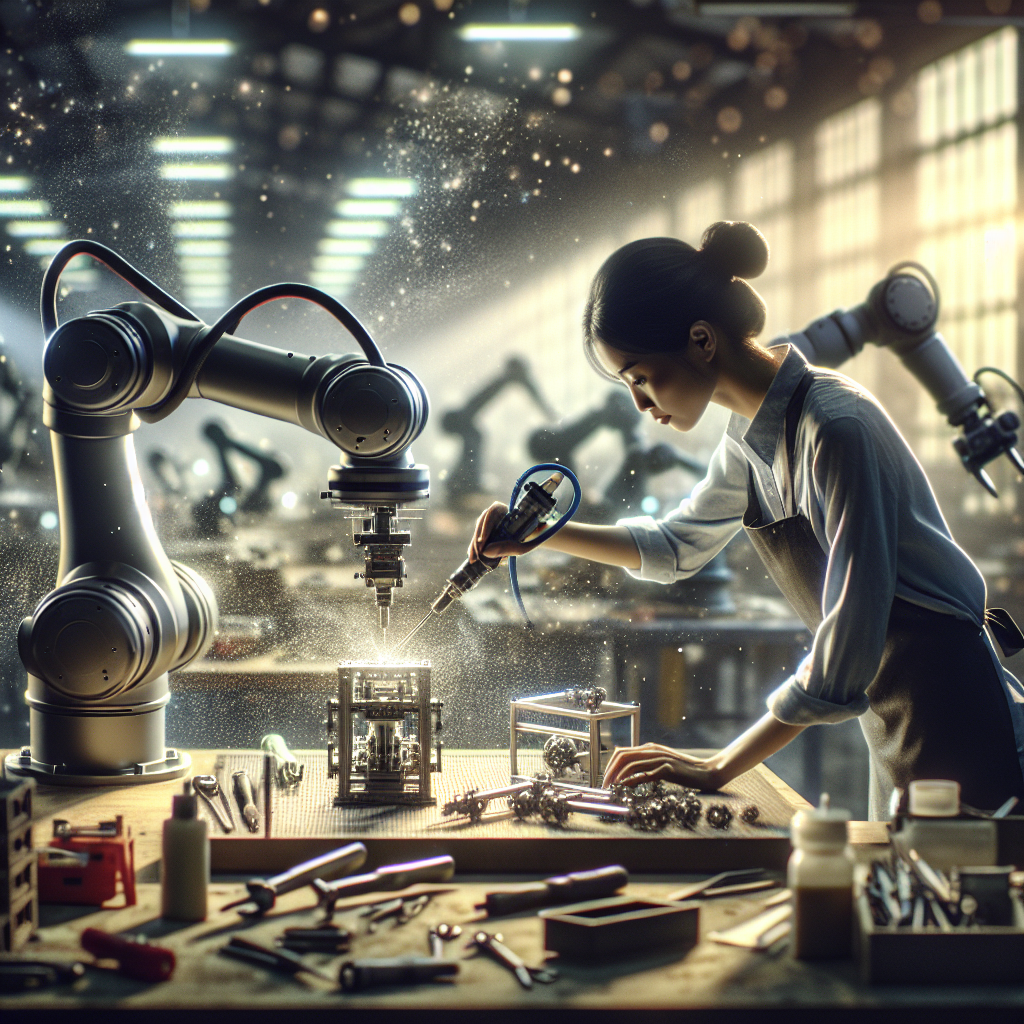
Robots in Manufacturing: How Modern Factories Use Robots (and Why Cobots Are the Future)
Over 4 million industrial robots are working in factories worldwide—and the fastest-growing segment is robots designed to work alongside humans, not replace them. Robots in manufacturing have moved from fenced-off assembly lines to shared floors where collaborative robots (cobots) and traditional factory robots handle welding, assembly, material handling, and quality inspection. This guide explains what factory robots do, how cobots in manufacturing differ from traditional industrial robots, who the key manufacturers are, and how Industry 4.0 and smart factories are changing the game. You'll also learn whether small businesses can afford automation. For the full picture of robot types including industrial and collaborative, see our types of robots guide. For the technology behind how robots sense and move, read our robot sensors and robot motors and actuators guides.
For a clearer view of how factory automation compares with the consumer and educational robots we review, read our Consumer vs industrial types guide.
What Robots Do in Factories
Welding
Welding robots—spot welding and arc welding—are the first and still largest application of industrial robots. In the automotive industry, robots in factories perform thousands of spot welds per vehicle with consistency and speed that human welders can't match. How do welding robots work in car factories? They follow programmed paths with high repeatability; sensors and seam-tracking keep quality consistent. How industrial robots transformed automotive manufacturing over 60 years is a textbook case of robotic manufacturing and assembly line robots.
Assembly
Assembly—electronic component placement, product assembly—relies on industrial automation robots for speed and precision. What jobs do robots do on an assembly line? They insert parts, fasten screws, apply adhesives, and place components with sub-millimeter accuracy. Automotive, electronics, and consumer goods all use assembly line robots. Manufacturing robots in assembly are often SCARA or articulated robots chosen for speed and reach.
Material Handling and Palletizing
Material handling and palletizing—picking, packing, stacking—are the fastest-growing applications. How Amazon uses robots in its warehouses and fulfillment centers (Kiva-style AMRs and mobile robots) is the best-known example; Amazon Robotics, Locus Robotics, Fetch, and others provide autonomous mobile robots for transport. Palletizing robots stack boxes and goods at end-of-line with consistent spacing and orientation. Robots in factories for material handling reduce walking time and injury while increasing throughput.
Painting and Coating
Painting and coating robots apply even spray patterns and keep workers out of hazardous environments. Automotive and aerospace use factory robots for paint booths; the robot's repeatability ensures uniform finish. Manufacturing automation in painting also reduces waste and improves consistency.
Quality Inspection
Quality inspection—vision-guided inspection, defect detection—increasingly uses quality inspection robots and AI. Robots in manufacturing can scan, measure, and classify defects more consistently than manual inspection. Machine learning in manufacturing is making these systems adaptive and more accurate.
Traditional Industrial Robots
The Big Four
FANUC, ABB, KUKA, and Yaskawa (Motoman) account for roughly 60% of the global industrial robot market. FANUC is a leader in automotive and general industrial automation; ABB and KUKA cover automotive, electronics, and heavy industry; Yaskawa is strong in motors and robots. How many industrial robots are there worldwide? According to the International Federation of Robotics (IFR), over 4 million operational units as of 2024; China, Japan, and South Korea have the highest density. Industrial automation robots from these vendors form the backbone of how factories use robots today.
Robot Types in Manufacturing
Articulated robots (typically 6-axis) are the most versatile—used for welding, assembly, and material handling. SCARA robots are fast and precise for assembly and pick-and-place in electronics. Delta robots offer high-speed picking for packaging and food. Cartesian (gantry) robots provide simple linear motion for machining and palletizing. Types of industrial robots used in manufacturing and their applications depend on payload, reach, speed, and robot cell layout. Our robot glossary defines terms like payload, reach, and repeatability.
Safety and Caging
Traditional industrial robots operate behind safety fences, light curtains, and safety scanners. ISO 10218 governs industrial robot safety; robot cells are designed so humans cannot enter the work envelope during operation. How do cobots work safely next to human workers? That's where collaborative robots and ISO/TS 15066 come in—cobots are force-limited and can share space with people. For how these systems are programmed, see our guide to robot programming.
Collaborative Robots (Cobots)
What Is a Cobot?
What is a cobot? A collaborative robot (cobot) is a robot designed to work alongside human workers without safety caging. It is force-limited and complies with ISO/TS 15066 so that contact with a person results in a safe stop or reduced force. How is it different from a regular industrial robot? Traditional robots are fast and powerful and must be caged; cobots sacrifice some speed and payload for safety and flexibility. Cobots in manufacturing are easier to program (often by hand-guiding or teach pendant), have a smaller footprint, and are more affordable—typically $25K–$65K vs $100K+ for a full industrial robot system. How collaborative robots work safely alongside human workers in factories is well defined by the standard: force and speed limits, rounded surfaces, and optional safety-rated monitoring.
Why Cobots Matter
Cobots make automation accessible to small and mid-size businesses. They're easier to deploy—no heavy robot cell integration—and can be redeployed between tasks. Can small businesses afford to use robots in manufacturing? Yes: a single cobot can cost $25K–$65K with often 12–18 month ROI; leasing and Robots-as-a-Service (RaaS) lower the barrier further. How cobots are different from traditional industrial robots explained simply: cobots are designed to share the workspace with people; traditional robots are designed to work alone behind fences.
Leading Cobot Manufacturers
Universal Robots is the cobot market leader. FANUC's CR series, ABB GoFa and SWIFTI, Doosan Robotics, and Techman offer alternatives with different payloads and reach. Which industries use the most robots? Automotive and electronics lead; food, pharma, and metalworking are growing. Cobots in manufacturing are increasingly used for machine tending, pick-and-place, and assembly in high-mix environments.
Cobot vs Traditional Robot
| Factor | Cobot | Traditional industrial robot |
|---|---|---|
| Safety | Works alongside humans; force-limited | Caged; high speed/payload |
| Speed | Slower (safety) | Fast |
| Payload | Typically <20 kg | Up to 2000+ kg |
| Cost | $25K–$65K | $50K–$500K+ |
| Programming | Hand-guiding, teach pendant, intuitive | Teach pendant, offline, PLC |
| Use cases | Assembly, tending, packing, flexible lines | Welding, heavy palletizing, high-speed assembly |
Can cobots do everything traditional robots can? No—cobots sacrifice speed and payload for safety; they're complementary. Cobot vs traditional industrial robot is a choice of task and budget.
Mobile Robots in Factories
AMRs and AGVs
What is the difference between an AMR and an AGV? AMRs (autonomous mobile robots) navigate dynamically using sensors and maps; AGVs (automated guided vehicles) follow fixed paths (magnetic strips, wires, or tape). AMRs are more flexible but typically more expensive. Amazon Robotics (Kiva-style), Locus Robotics, Fetch, and Geek+ provide AMRs for warehouse and factory material transport. How robots are used in factories and manufacturing for logistics is one of the fastest-growing segments.
Mobile Manipulators
Mobile manipulators—a mobile base plus a robot arm—can pick, move, and place anywhere in the facility. They're the next frontier for flexible manufacturing and how to get started with robotics automation in a small factory when space and tasks vary.
Industry 4.0 and Smart Factories
Digital Twin
A digital twin is a virtual replica of the factory or robot cell—used to simulate changes before implementing them and to monitor real-time performance. What is Industry 4.0 and how do robots fit into it? Industry 4.0 connects machines, data, and people; robots are key actors that generate data and execute tasks. Smart factory and robotic manufacturing with digital twin support reduce downtime and improve planning.
AI and Machine Learning in Manufacturing
AI and machine learning enable predictive maintenance, adaptive quality control, and production optimization. How Industry 4.0 and smart factories use robots and AI together is evolving—vision systems, anomaly detection, and scheduling are common applications. The Robot Report and IEEE Spectrum cover trends in manufacturing automation and production robots.
Lights-Out Manufacturing
What is a lights-out factory? A facility that operates without human presence—fully automated from raw material to finished product. Lights-out manufacturing is rare; FANUC's own factory is a famous example. How do robots make it possible? Through full automation of every process step and robust monitoring. Most factories remain manned with robots augmenting human labor.
Can Small Businesses Afford Robots?
The Cobot Entry Point
How much does an industrial robot cost for a small manufacturing business? A cobot can run $25K–$65K with often 12–18 month ROI; leasing and financing are available. How much does an industrial robot cost? Traditional systems: $50K–$500K+; total system cost including integration is often 3–5x the robot. Cobots lower the entry point and reduce integration complexity—no need for a full robot cell with safety fencing. How to get started with robotics automation in a small factory often begins with a single cobot on a repetitive task (e.g. machine tending, pick-and-place), then expands as the team gains experience.
Robots-as-a-Service (RaaS)
RaaS—subscription or pay-per-hour models—lowers upfront cost. You pay for robot capacity without owning the hardware; the vendor handles maintenance and updates. When automation makes sense: high-volume repetitive tasks, hazardous environments, quality consistency requirements, and labor shortages. Are robots replacing factory workers or helping them? Robots replace specific tasks; workers often shift to programming, maintenance, and supervision. Net employment impact is debated; in many countries with high robot adoption, manufacturing employment has remained stable while productivity rose. Production robots and automated manufacturing work best when the task is well-defined and repeatable—then machine automation pays off in consistency and throughput.
FAQ
What is a cobot?
A cobot (collaborative robot) is designed to work safely alongside human workers without safety caging. It is force-limited per ISO/TS 15066. Cobots are easier to program and deploy and are used for assembly, machine tending, and material handling in shared workspaces.
How many industrial robots are there worldwide?
Over 4 million operational units as of 2024, per the IFR. China, Japan, and South Korea have the highest density. Industrial robots and factory robots continue to grow, with cobots and AMRs among the fastest-growing segments.
Will robots replace factory workers?
Robots replace specific tasks, not entire jobs. Workers often shift to programming, maintenance, and supervision. Net employment impact is debated; historically, manufacturing employment in high-adoption countries has been stable while productivity increased.
How much does an industrial robot cost?
Traditional: $50K–$500K+; cobot: $25K–$65K. Total system cost including integration is often 3–5x the robot. Robots in manufacturing ROI depends on application and labor costs.
What is the difference between an AMR and an AGV?
AMRs navigate dynamically using sensors and maps; AGVs follow fixed paths (e.g. magnetic strips or wires). AMRs are more flexible but typically more expensive. Both are used for material transport in factory automation.
What is a lights-out factory?
A manufacturing facility that operates without human presence—fully automated from raw material to finished product. Only a handful exist worldwide; FANUC's own factory is a leading example.
Which industries use the most robots?
Automotive, electronics, food and beverage, pharmaceuticals, and metal and machinery. Automotive was first and remains the largest adopter of industrial robots and robots in manufacturing. How robots are used in electronics manufacturing and semiconductor fabs is another major segment—cleanrooms and precision assembly rely heavily on SCARA and articulated robots. Which industries use the most robots in manufacturing? IFR data consistently ranks automotive and electronics at the top by unit count and density.
Can cobots do everything traditional robots can?
No. Cobots sacrifice speed and payload for safety. They're complementary: cobots handle lighter, more flexible tasks in shared spaces; traditional robots handle heavy, high-speed work behind fences.
Conclusion
Robots in manufacturing are mature, proven technology—and they're becoming more accessible through cobots, AMRs, and RaaS models. Industrial robots and factory robots from FANUC, ABB, KUKA, Yaskawa, and Universal Robots power everything from automotive welding to electronics assembly to warehouse logistics. The trend is smaller, smarter, more collaborative, and more affordable—the cobot revolution is real. To see all IEEE Robots Guide — types of robots including industrial and collaborative, visit our types of robots guide. To understand how robots work from sensors to programming, start with our how robots work guide and the rest of the knowledge base.
Outside the factory floor, similar teleoperation and logistics patterns show up in patient care—our guide to robots in healthcare covers surgery, rehab, and hospital delivery robots for contrast.