
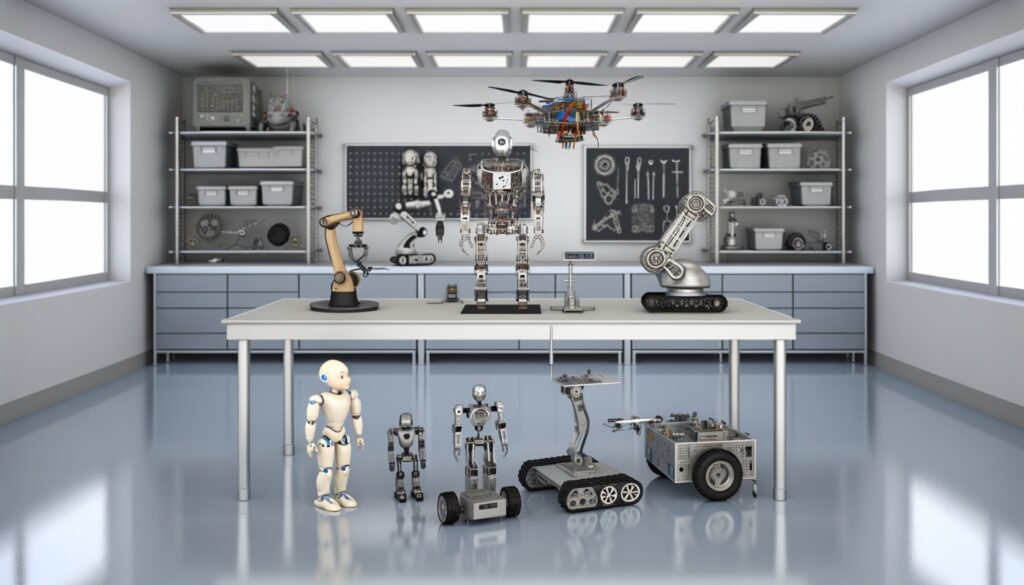
Robotics technology has advanced to a point where classification requires more than just mechanical categories. Modern robots are defined by their application domain, mobility characteristics, and intelligence levels. To understand the fundamental definition of these systems, refer to our what is a robot guide for a baseline perspective.
This guide provides a definitive framework for identifying different robot types and choosing the most effective category for your specific requirements. Whether you are a business evaluator looking for automation ROI or a hobbyist selecting your first kit, this framework routes you to the correct decision path.
- For Business Evaluators: Focus on the Industrial and Selection Framework sections to calculate ROI and precision needs.
- For Hobbyists and Students: Start with the Educational and Hobbyist category for kit recommendations and learning curves.
- For Technical Developers: Explore the Mobile Robots section for AGV vs AMR vs Cobot technical distinctions.
Canonical Robot Classification and Capability Matrix
To choose the right robot type, you must first understand the technical thresholds that separate each category. The following matrix provides a canonical reference for the primary robot classifications based on performance metrics, environment, and cost.
This framework requires an objective assessment of your payload needs and autonomy requirements before you commit to a specific hardware platform.
| Robot Category | Primary Application | Typical Payload | Mobility Mode | Autonomy Level | Budget Range |
|---|---|---|---|---|---|
| Industrial | Manufacturing/Assembly | 1kg – 1000kg+ | Stationary/Fixed | Pre-programmed | $50,000 – $500,000+ |
| Service | Human Assistance | 1kg – 50kg | Legged/Wheeled | Semi-autonomous | $1,000 – $50,000 |
| Mobile (AMR/AGV) | Logistics/Transport | 10kg – 500kg | Wheeled/Tracked | Autonomous | $5,000 – $100,000 |
| Humanoid | Social/Interaction | 5kg – 25kg | Bipedal (Legged) | AI-Integrated | $10,000 – $1,000,000+ |
| Educational | Learning/Kits | < 2kg | Various | Programmed | $25 – $2,000 |
Understanding these thresholds justifies the selection of a specific robot type over another. For instance, an industrial articulated arm supports high-precision assembly but requires a fixed safety cage. The choice of a stationary system allows for maximum power delivery and mechanical rigidity that mobile bases cannot support.
Conversely, a service robot supports interaction in human spaces but lacks the repeatability of manufacturing systems. High-signal search data from 2025 indicates that the “variant-list” intent—where users seek “7 types of robots with examples”—is best satisfied by comparing these core categories against specific use cases like warehouse fulfillment or medical surgery.
The classification framework routes users through five primary decision gates. First, you must define the physical environment, as stationary systems and mobile systems require entirely different infrastructure. Industrial environments often necessitate heavy-duty electrical drops and reinforced floors, while domestic environments require high levels of obstacle avoidance and social compliance.
Second, you must determine the payload threshold, which dictates the actuator power and structural rigidity needed. Third, the precision requirement distinguishes industrial-grade systems (sub-millimeter) from service-grade systems (centimeter-level). High-precision tasks like electronics surface-mounting require SCARA or Delta robots that minimize vibration and thermal drift.
Fourth, the autonomy requirement determines if the robot requires a controlled path (AGV) or can navigate dynamically (AMR). A controlled path supports lower software complexity but requires higher infrastructure investment. A dynamic AMR supports flexible workflows but necessitates a higher initial sensor and processing cost to handle unpredictable hallway traffic.
Finally, the budget constraint filters the available technologies to a feasible shortlist. By following this Spo-based logic, you ensure that every technical choice supports your ultimate project goal. This systematic approach reduces the risk of environment-to-hardware mismatch and ensures that you do not overpay for capabilities that your specific task does not require.
Current market evidence from the International Federation of Robotics (IFR 2025) supports the growth of the “Service” and “Mobile” categories as the most rapid sectors of the industry. While industrial robots maintain the highest total market value at $16.2 billion, the service robot sector has reached 15 million units annually. This growth is driven by the declining cost of depth sensors and the rise of edge AI processing.
This shift justifies a move away from traditional “fixed automation” toward “flexible robotics” that can adapt to changing human environments. Practical evaluators should note that the complexity of a system often correlates with its learning curve. A simple educational kit requires only 2-8 weeks of study for basic proficiency.
In contrast, an industrial system necessitates 6+ months of professional training for safe operation and advanced programming. Choosing the right path requires balancing your immediate task needs against your long-term internal technical capabilities. Every successful implementation begins with an objective assessment of these performance and intelligence thresholds.
Quick Selection Guide: Ease, Cost, and Complexity
This quick lookup table helps you compare the relative accessibility and investment requirements for each major robot category. Use the star ratings (★) to identify the best starting point for your technical skill level and budget. Beyond the ratings, understanding the “Decision Logic” for each category ensures that your choice aligns with the core entity and intent of your project.
| Robot Category | Ease of Setup | Implementation Cost | Technical Complexity | Recommended For |
|---|---|---|---|---|
| Educational | ★★★★★ (Easy) | ★ (Low) | ★ (Simple) | Students, Beginners |
| Service | ★★★★ (Moderate) | ★★ (Medium) | ★★ (Intermediate) | Small Business, Homes |
| Mobile (AMR) | ★★★ (Difficult) | ★★★ (High) | ★★★★ (Complex) | Logistics, Warehousing |
| Industrial | ★★ (Very Hard) | ★★★★ (Very High) | ★★★★★ (Advanced) | Manufacturing, Assembly |
| Humanoid | ★ (Expert Only) | ★★★★★ (Extreme) | ★★★★★ (Advanced) | Research, Interaction |
The “Ease of Setup” rating justifies the selection of educational platforms for initial skill development. A five-star rating indicates that the system is “out-of-the-box” ready, typically requiring only a standard PC and basic visual programming software. This routes students toward immediate success, which is critical for maintaining engagement in the early stages of engineering education. These systems support modular expansion, allowing users to gradually increase complexity as their coding skills move from blocks to text-based languages like C++ or Python.
The “Implementation Cost” column reflects the hardware acquisition and integration expenses. A one-star rating for educational kits indicates a budget under $1,000, while a five-star rating for humanoid research platforms signifies an investment often exceeding $100,000. This cost delta supports the conclusion that humanoid robots are currently reserved for academic research and high-end industrial R&D. Business evaluators must consider that “implementation” also includes safety compliance and infrastructure modification. An industrial robot requires a fixed safety cage and specialized power drops, which can double the initial hardware cost during the integration phase.
Technical complexity measures the level of math and software expertise required to operate the system effectively. High-complexity systems (4-5 stars) require a deep understanding of inverse kinematics, control theory, and real-time operating systems (RTOS). For instance, programming an articulated industrial arm justifies the use of specialized languages like Kuka’s KRL or Fanuc’s Karel. In contrast, service robots use more “black-box” software that handles navigation and interaction through pre-built AI modules. This lower complexity supports adoption by non-specialized staff in environments like hospitals or hotels where technical expertise is limited.
The “Recommended For” section routes you to the correct category based on your role. If you are a manufacturing engineer focused on high-volume production, the industrial category is your primary focus. If you are a facility manager looking to automate floor cleaning or internal logistics, the service and mobile categories provide the best ROI. Every selection must prioritize the “Central Intent” of the robot’s deployment. A failure to match the recommended user type to the hardware supports a failure in long-term project sustainability. Use this matrix to justify your budget allocation and technical roadmap before contacting manufacturers for quotes.
Finally, consider the maintenance complexity which often mirrors the setup difficulty. Industrial and humanoid systems require scheduled lubrication, sensor calibration, and software updates that necessitate a dedicated technical team. Service and educational systems are designed for higher reliability with lower intervention. Choosing a robot with a higher complexity than your team can support justifies an additional investment in service contracts or professional training. This guide ensures that you evaluate the “Total Cost of Capability” rather than just the initial purchase price, providing a more accurate ROI projection for your automation journey.
Industrial Robots for Manufacturing and Assembly Precision
Industrial robots represent the foundation of modern automated production. This category requires high-performance actuators and rigid structural components to maintain precision under load. Unlike social or educational robots, industrial systems prioritize repeatability and uptime over interaction or aesthetics. The global industrial market now supports over 2.7 million units operating in sectors ranging from automotive assembly to pharmaceutical packaging.
Choosing an industrial robot type requires a detailed analysis of degrees of freedom and reach requirements. This analysis ensures the robot can access all parts of the work envelope without mechanical interference. The payload capacity of an industrial arm directly supports its ability to handle heavy raw materials or large sub-assemblies. Every industrial installation must include a robust safety plan to protect human workers from high-speed, high-force movements.
Articulated Robots and Multi-Joint Flexibility
The articulated robot is the most versatile industrial type. It features a minimum of three rotary joints and typically provides six degrees of freedom. This design supports complex movements like welding, painting, and intricate assembly tasks. Modern articulated arms achieve positioning accuracy of ±0.02mm, which justifies their use in high-precision automotive applications. This precision is managed through sophisticated robot control systems that monitor joint encoder feedback in real-time. A 6-axis articulated robot supports reach in a near-spherical workspace. This allows it to access parts from multiple angles that stationary Cartesian systems cannot reach.
Cartesian and Gantry Systems for Linear Tasks
Cartesian robots, also known as gantry robots, operate on three linear axes (X, Y, and Z). This design supports high rigidity and excellent repeatability for tasks like pick-and-place or CNC machining. Because Cartesian robots use linear slides rather than rotary joints, they maintain ±0.01mm accuracy across large workspaces. This type requires a significant footprint but supports the heaviest payloads in the industrial category. Payloads often exceed 1,000kg for heavy-duty gantry systems used in aerospace or construction.
SCARA and Delta Robots for High-Speed Operation
The Selective Compliance Assembly Robot Arm (SCARA) and Delta robot categories are optimized for speed. A SCARA robot supports high-speed assembly in a horizontal plane while remaining rigid in the vertical axis. This justifies its use in electronics manufacturing where parts must be placed quickly and accurately. Delta robots use a parallel kinematic structure to achieve ultra-high accelerations. A modern Delta robot supports cycle times as fast as 0.1 seconds per operation. This speed requires lightweight components and advanced control algorithms to prevent vibration during rapid deceleration.
Collaborative Robots (Cobots) and Human Safety
Cobots represent a specialized sub-category of industrial robots designed to work alongside humans. Unlike traditional industrial arms, a cobot supports power and force limiting (PFL). This means the robot stops immediately upon contact with a human, ensuring safety without physical barriers. Cobots typically support smaller payloads ranging from 3kg to 20kg. This trade-off justifies their use in small-to-medium enterprises where space is limited and floor layouts change frequently. Every cobot implementation requires a thorough risk assessment to ensure the entire system—including the end-effector—is safe for human interaction.
Factual claims regarding industrial performance are sourced from the IFR World Robotics 2025 report. This report indicates a 12% annual increase in global installations, driven by the electronics and automotive sectors. This trend supports the conclusion that manufacturing precision remains the primary driver for industrial robot selection. For those interested in the software implementation, our guide on robot programming languages provides the necessary technical foundation for industrial deployment. Practical evaluators must consider that the total cost of ownership includes integration and maintenance. Choosing the wrong type supports a failure in process efficiency and reduces the long-term ROI. Correct matching of task to robot geometry is critical for long-term project success.
Service Robots for Human Assistance and Interaction
Service robots are designed to perform useful tasks for humans outside of industrial manufacturing environments. This category requires advanced perception and interaction capabilities to navigate dynamic spaces like homes and hospitals. While industrial robots focus on “tasks,” service robots focus on “assistance.” The global service robot market reached $8.5 billion in 2025, driven by the mass adoption of domestic cleaning systems. Selecting a service robot type requires an evaluation of the interaction complexity needed to function safely around people.
The level of autonomy dictates the safety protocols and sensor suites required for deployment. Service robots must prioritize human safety and social acceptance over raw mechanical speed. Every service robot choice must consider the “Human-in-the-Loop” requirement, where a human may need to intervene or provide high-level commands. These systems justify their cost by reducing the burden of repetitive, dull, or dangerous tasks for human staff. Successful service robotics projects route resources away from manual labor toward higher-value human interaction and care.
Domestic and Household Assistance Systems
Domestic robots are the most common service type. This sub-category includes robotic vacuums, floor mops, and lawn mowers. A modern robotic vacuum supports LIDAR-based mapping and AI object recognition. This justifies its use in complex household layouts where manual cleaning is inefficient. These robots perform repetitive chores with 95% cleaning efficiency compared to manual methods. Household robots require minimal user training and operate on systematic schedules. The transition from random-bounce navigation to systematic mapping supports faster cleaning times and better coverage for modern smart homes.
Healthcare and Medical Robotic Systems
Medical robots are the most critical sub-category of service robotics. This includes surgical assistants, rehabilitation exoskeletons, and pharmacy dispensers. A surgical robot like the da Vinci system supports sub-millimeter precision and provide 3D visualization. This technology justifies minimally invasive procedures that reduce recovery time by up to 50%. Rehabilitation robots support guided movement therapy for stroke victims. These systems provide consistent assistance forces ranging from 10N to 500N. Medical robots must meet strict regulatory standards and provide a level of consistency that manual healthcare cannot match.
Commercial and Professional Service Robots
Commercial service robots operate in public and professional spaces. This category includes security patrol robots, hotel delivery bots, and large-scale floor scrubbers. A security robot supports 360-degree surveillance and thermal imaging. This justifies its use for 24/7 monitoring of large commercial facilities. Delivery robots in hospitals route items autonomously between floors using elevator integration. These robots require robust safety systems to navigate through crowded hallways. The efficiency gains from automated delivery support better staff allocation, allowing human workers to focus on high-value tasks while robots handle routine logistics.
The performance of service robots depends on their sensor suite and AI processing power. Unlike the pre-programmed paths of industrial robots, service robots require “Sense-Plan-Act” cycles to handle unpredictable behavior. High-demand queries for “types of service robots” highlight a specific interest in healthcare and domestic applications. To satisfy this intent, evaluators should focus on the autonomy level of the specific hardware platform. Every service robot choice must prioritize social acceptance and safety. This ensures successful deployment in human-centric environments without causing friction or anxiety for the end-users.
Mobile Robots for Transportation, Logistics, and Exploration
Mobile robots are categorized by their ability to move through an environment rather than remaining in a fixed location. This category requires sophisticated navigation technologies and power management systems. The mobile robot sector was valued at $6.4 billion in 2025. This market is split between indoor logistics and outdoor exploration. To choose the right mobile type, you must understand the distinction between guided systems (AGV) and autonomous systems (AMR). Environmental constraints also dictate the locomotion mode, whether wheeled, legged, or aerial.
The core capability of a mobile robot is its “Spatial Awareness”—the ability to know where it is and what is around it. This justifies the use of SLAM (Simultaneous Localization and Mapping) algorithms and multi-sensor fusion. Mobile robots route goods and data through complex environments, reducing the need for fixed conveyor systems. Every mobile robot implementation requires a robust “Mission Control” layer to manage fleet coordination and battery management. Successful deployment of mobile robotics justifies the move toward “lights-out” logistics where robots handle the entire transport chain autonomously.
AGV vs AMR: The Navigation Distinction
The distinction between Automated Guided Vehicles (AGV) and Autonomous Mobile Robots (AMR) is the most important technical choice in logistics. An AGV requires a fixed path, such as magnetic tape or wires in the floor. This justifies its use in stable, high-volume warehouses where paths do not change. An AMR supports dynamic navigation using SLAM. This means the AMR can detect an obstacle and plan a new route without human intervention. AMRs support flexible manufacturing and are more easily scaled than AGV systems. Choosing an AMR justifies a higher initial cost by providing long-term adaptability as facility layouts evolve.
Ground, Aerial, and Underwater Domains
Mobile robots operate in three primary physical domains. Ground-based robots use wheels, tracks, or legs to transport goods across facility floors. Aerial robots, or drones (UAVs), support surveillance and delivery tasks from above. A multi-rotor drone supports stable hovering, which justifies its use for bridge inspections. Underwater robots (AUVs and ROVs) operate in high-pressure aquatic environments. An AUV supports independent deep-sea mapping at depths up to 6,000 meters. Each domain requires specialized hardware for mobility, prioritizing either aerodynamics, traction, or buoyancy control.
Space Exploration and Extreme Environments
Space robots represent the peak of mobile robot engineering. This category includes planetary rovers and orbital maintenance systems. A Mars rover like Perseverance supports autonomous navigation across rough terrain with limited communication. This justifies the use of radiation-hardened electronics and specialized thermal management. Space robots must operate with extreme reliability because repair is impossible. They provide the only means for humans to conduct detailed geological research on other planets. The technology developed for space rovers often routes back to terrestrial applications, such as advanced computer vision for search and rescue robots.
Search-demand data confirms that users are increasingly interested in the “AMR vs AGV” comparison. Factual evidence from 2025 shows an 18% growth in autonomous systems, significantly outpacing guided systems. This trend justifies a “mobile-first” approach for new warehouse installations. Practical evaluators should note that mobile robots require specialized proximity sensors for safety and localization. A failure in sensor selection supports a failure in obstacle avoidance and poses a risk to personnel. Every mobile robot implementation must include a defined safety mode that prioritizes human safety in shared workspaces without sacrificing mission efficiency.
Humanoid and Social Robots for Interaction and Research
Humanoid robots are designed to mimic the human form and behavior to facilitate natural interaction in environments built for people. This category represents the most significant engineering challenge in terms of bipedal balance, facial expression, and social intelligence. While currently a smaller commercial market at $2.8 billion, the humanoid sector is the primary driver for AI and bipedal locomotion research. Choosing a humanoid robot type requires an assessment of whether the goal is “social presence,” “experimental development,” or “general-purpose labor.” Every humanoid platform must balance mechanical power with the delicate sensors needed for human-safe interaction.
The development of humanoid systems justifies the convergence of advanced materials science and deep learning. To achieve human-like movement, these robots require high-torque actuators and fast feedback loops that can adjust for shifts in center of mass within milliseconds. This technical requirement routes research toward “Electric Actuators” and “Soft Robotics” that mimic human muscle behavior. As these systems become more capable, they support applications in elder care, disaster response, and high-risk maintenance tasks where a human-like form is necessary to operate tools or navigate stairs. The social aspect of humanoids justifies their use in environments where a traditional wheeled robot would feel out of place or mechanical.
Research Humanoids and Bipedal Locomotion
Research humanoids like Boston Dynamics’ Atlas are built to push the limits of robotic physics and control theory. A research humanoid supports dynamic balance, allowing it to jump, run, and navigate uneven terrain that would stop a wheeled system. This capability justifies the study of human-centric environments where mobility is the primary constraint. These platforms require hundreds of high-speed sensors, including IMUs (Inertial Measurement Units) and force-torque sensors in the feet. Research in this category routes progress to other fields like prosthetic design and advanced gait analysis for medical rehabilitation. These robots are typically too expensive for commercial use but serve as the “Formula 1” of the robotics world, driving innovation across the entire industry.
Social and Companion Robots
Social robots focus on communication and emotional connection rather than physical labor. This sub-category includes companion bots for the elderly and educational assistants for children. A social robot supports natural language processing (NLP) and emotional recognition through computer vision. This justifies its use in healthcare settings to provide reminders, monitor safety, and reduce social isolation. These robots do not require the strength of industrial arms, but they do require high levels of social acceptance. Successful social robots use simplified human features and expressive eyes to build trust. This design approach avoids the “Uncanny Valley” where a robot’s appearance is close enough to human to feel unsettling.
Entertainment and Artistic Systems
Entertainment humanoids are used in theme parks, public performances, and digital media production. This category prioritizes lifelike movement and facial animation over functional utility or physical payload. An artistic humanoid supports complex choreographies and can even generate original works of art using embedded generative AI. This technology justifies the intersection of robotics and the performing arts, providing engaging experiences for global audiences. While these robots are often custom-built for specific shows, they demonstrate the potential for robots to handle non-repetitive, creative tasks. The integration of high-resolution facial actuators allows these robots to convey complex emotions, making them effective for storytelling and brand engagement.
The 2025 growth in humanoid robotics is closely tied to the “AI-Integrated” autonomy level. As large language models (LLMs) are embedded into robot controllers, humanoids are gaining the ability to understand complex verbal instructions and environmental context. This evolution is detailed in our report on how AI is improving robot abilities. This justifies their future role as “general-purpose” assistants that can perform a wide variety of household and industrial tasks. Practical evaluators should be aware that the Humanoid category currently has the highest learning curve (1+ years) and the most significant maintenance requirements. Every humanoid project must consider the long-term reliability of complex bipedal joints. A failure in joint maintenance supports a failure in balance, which can lead to expensive hardware damage during operation.
Finally, the ethical and social implications of humanoid robots must be evaluated before deployment. The anthropomorphic form justifies a higher level of user engagement but also creates higher expectations for intelligence and empathy. Successful implementations route resources toward “User-Centered Design” to ensure the robot’s behavior aligns with cultural norms and safety expectations. As bipedal systems move from the lab to the real world, their success will be measured by their ability to assist humans without causing disruption or fear. This guide ensures that you evaluate both the technical performance and the social impact of your humanoid selection, providing a holistic view of this rapidly evolving robotic category.
Educational and Hobbyist Robotics for Learning and Skill Development
The educational robot category is designed to teach the fundamentals of robotics, programming, and mechanical engineering. This sector is valued at $3.1 billion and serves as the primary entry point for students, makers, and professional researchers. Unlike industrial systems, educational robots prioritize ease of use, comprehensive documentation, and safe experimentation. Choosing an educational robot type requires matching the kit’s complexity to the learner’s current skill level, from primary school visual coding to university-level AI research. These systems justify their existence by building the talent pipeline for the broader robotics industry.
The modularity of educational platforms supports a “Learn-by-Doing” approach that is critical for mastering complex engineering concepts. By building and programming a robot from scratch, students gain a deep understanding of sensor feedback, motor control, and logic loops. This educational process routes learners toward STEM (Science, Technology, Engineering, and Math) careers, providing a foundation for future innovation. Educational robots also support “Soft Skills” such as problem-solving, collaboration, and project management. As students work through technical challenges, they justify their learning time by producing functional, autonomous machines that can solve real-world puzzles or compete in global events.
Programmable Kits and Coding Foundations
Robot kits like LEGO Mindstorms and VEX provide a structured environment for learning at the primary and secondary levels. A programmable kit supports “visual coding” interfaces, where students drag and drop blocks to create complex logic without the barrier of syntax errors. This justifies its use in classrooms to teach the basics of “if-then” statements and proportional-integral-derivative (PID) control. These kits include reconfigurable motors, sensors, and structural parts that can be used for hundreds of different challenges. Visual coding routes students toward “text-based” languages like Python as their skills improve. This progressive learning path ensures that the student is not overwhelmed by initial technical complexity while still achieving functional robot behavior. For a practical starting point, see our tutorial on building your first simple robot to apply these concepts in a hands-on environment.
Arduino and Raspberry Pi Platforms for Makers
For more advanced learners and hobbyists, microcontrollers like Arduino and Raspberry Pi are the industry standard for custom robot builds. We provide a comparison of Arduino vs Raspberry Pi to help you select the correct processor for your project’s intelligence requirements. An Arduino-based robot supports low-level hardware control and C++ programming, which justifies its use for learning electronics and sensor integration. A Raspberry Pi robot supports a full Linux operating system and high-level AI libraries like OpenCV or TensorFlow. This means the robot can handle computer vision and complex networking tasks. Makers choose these platforms for their “open source” nature, which allows for infinite customization. These platforms require more technical skill but provide a deeper understanding of the “Hardware-Software” integration that drives professional robotics.
Competition and Research Platforms
Competition robots are built for high-stakes events like FIRST Robotics or RoboCup, where teams must solve seasonal challenges under time pressure. This category requires engineering rigor and teamwork to design, build, and iterate on specialized mechanisms like intake rollers or high-speed drive bases. Participating in these events justifies the development of project management skills and strategic thinking. Research-grade educational robots, like the NAO or Pepper, are used in universities to study human-robot interaction and social AI. These platforms provide a consistent baseline for researchers worldwide to compare their algorithms. The use of standardized research platforms justifies the collaborative nature of the global robotics community, allowing for faster breakthroughs in AI and autonomy.
Educational robotics is the fastest-growing sector for personal development and lifelong learning. High-demand search queries for “types of robots with examples” often lead users to these kits as their first hardware purchase. Practical evaluators recommend starting with a kit that has strong “community support”—thousands of online tutorials, forums, and code repositories to help with troubleshooting. You can explore the available frameworks in our guide to open source robot software. Every educational project should focus on “experimentation” over “perfection,” as failure is the primary mechanism for learning. By choosing a modular system, you support long-term skill growth and ensure your hardware can adapt as you move from beginner to advanced concepts. This guide ensures that you select a platform that grows with your skills, providing a sustainable and engaging path into the world of robotics.
Finally, consider the “Extensibility” of the educational platform before purchase. A closed system may be easier to start with but limits your growth as you move toward professional engineering. Open-source platforms like ROS (Robot Operating System) justify their learning curve by being the same software used in industrial and mobile robotics. Routing your education toward industry-standard tools ensures that your hobbyist skills are directly transferable to a professional career. Successful educational robotics implementations prioritize “Open-Ended Challenges” that encourage students to think creatively about how robots can solve problems in their own communities. This approach justifies the investment in educational technology as a long-term benefit to society and the workforce.
Troubleshooting Common Robotics Implementations
Implementing a robotic system involves navigating significant technical friction points that can impact uptime and safety. This troubleshooting guide provides a systematic approach to resolving common issues in the setup, reliability, and environmental phases of deployment. By following these evidence-based steps, you justify your maintenance budget and ensure the long-term performance of your robotic assets. Successful troubleshooting routes technical problems away from “system failure” toward “controlled maintenance,” preventing expensive downtime in industrial and commercial settings. Every robotic platform requires a dedicated “Incident Response” plan to handle the unpredictable nature of real-world operation.
The process of troubleshooting justifies the use of “Predictive Maintenance” tools like thermal imaging and vibration analysis. By identifying early signs of wear in motors or joints, you can schedule repairs before a catastrophic failure occurs. This proactive approach supports higher reliability and extends the life of the robot’s actuators. In complex systems, “Digital Twins” support remote troubleshooting by allowing engineers to simulate the robot’s behavior in a virtual environment. This technology routes diagnostic data from the physical robot to a cloud-based model, identifying software bugs or mechanical misalignments without requiring on-site intervention. A well-maintained robot is a safe robot, and consistent troubleshooting is the foundation of high-performance automation.
Setup and Configuration Problems
Calibration errors are the most common issue during the initial setup of industrial and medical robots. If an industrial arm misses its target by even 1mm, it requires a full joint-level recalibration and a check of the “Home” position. This calibration process justifies the time spent on installation, ensuring that the robot’s internal model matches the physical reality of the workspace. Sensor interference often causes mobile robots to stop unexpectedly or “get lost” in a mapped environment. Check for reflective surfaces like glass walls or high-frequency electronic noise that might “jam” LIDAR or ultrasonic sensors. Routing cables away from power lines and using shielded sensors supports higher data integrity and reduces “phantom” obstacle detection during navigation.
Performance and Reliability Issues
Drift in positioning accuracy often supports a failure in the feedback loop or mechanical wear in the drive train. Check that encoders are clean and that mechanical backlash in the gearboxes is within manufacturer tolerance. In mobile systems, battery degradation often reduces mission duration, leading to stalled robots in high-traffic areas. Implement a “Charge-on-Idle” safety mode to ensure the robot never loses power in a remote or inaccessible location. If a service robot becomes sluggish or unresponsive, it justifies a check of the “Background AI” processes. Overloaded processors can lead to latency in obstacle avoidance, which is a significant safety risk in human-centric environments. Clear the cache and update the firmware to ensure the robot has the latest performance optimizations.
Integration and Environment Conflicts
Communication latency justifies a failure in multi-robot coordination and fleet management. Ensure that your local Wi-Fi or 5G network supports the high bandwidth required for real-time ROS (Robot Operating System) data transmission. If a robot fails in an outdoor or harsh environment, check for ingress protection (IP) rating violations. Environmental moisture, dust, or extreme temperatures can “route” to electronic failure if the housing is not correctly sealed. Regular inspection of seals and filters justifies the robot’s deployment in “Dirty and Dangerous” tasks. If the robot’s AI fails to recognize new objects, it supports the need for “Model Retraining.” Regularly updating the object detection library ensures that the robot can adapt to changes in the facility layout or new types of cargo.
Finally, documentation is the most powerful tool in any troubleshooting toolkit. Maintaining a “Maintenance Log” justifies every intervention and provides a historical record of system performance. This data routes future troubleshooting efforts toward the most likely failure points, reducing “Mean Time to Repair” (MTTR). If a recurring issue cannot be resolved, it justifies a “Root Cause Analysis” with the manufacturer to identify potential design flaws. Training your staff on these standard troubleshooting protocols supports a culture of “Technical Ownership” and ensures that your robotic implementation remains resilient. Every successful project builds on the lessons learned during these inevitable friction points, creating a more robust and capable automation ecosystem for the future.
Robot Selection Framework and Decision Checklist
Selecting the correct robot type requires a systematic evaluation of your unique requirements and operational constraints. This framework consolidates duplicate decision logic and routes you to the most efficient hardware category for your specific use case. By following this Spo-based logic, you ensure that every technical decision supports the “Central Intent” of your project, whether it is increasing manufacturing throughput or improving domestic quality of life. An objective selection process justifies your capital expenditure and ensures that the technology can grow with your needs. A failure in selection often routes to project abandonment, making this framework a critical first step for any robotics journey.
The “Total Cost of Capability” justifies the need for a detailed ROI (Return on Investment) analysis during the selection phase. Beyond the hardware price, you must account for “Integration Complexity”—the time and labor needed to make the robot work in your environment. This includes safety certifications (such as ISO 10218 for industrial robots), software development, and staff training. A successful selection framework supports “Future-Proofing,” ensuring that the robot’s controller and mechanical interface can handle updated tasks over a 5-10 year lifecycle. By recording your “Must-Have” performance metrics, you create a baseline for vendor evaluation and performance testing. This rigorous approach routes your resources toward high-impact automation that delivers measurable results.
Step 1: Application and Task Definition
Identify the primary action the robot must perform with extreme clarity. If the task is “manufacturing precision parts,” you require an Industrial robot with high repeatability. If the task is “assisting humans in a social space,” you require a Service or Humanoid robot with advanced interaction sensors. Clearly defining the task justifies the next steps in the selection process and prevents you from over-engineering the solution with unnecessary degrees of freedom. Ask yourself: “Does this task require 6-axis movement, or can it be solved with a simpler 3-axis gantry?” This fundamental question routes you toward the most cost-effective mechanical architecture for your project.
Step 2: Environment and Mobility Assessment
Determine if the robot will operate in a “fixed location” or “move through space” autonomously. Fixed tasks support higher precision and much heavier payloads because the system is anchored to a rigid base. Mobile tasks require “Spatial Awareness” and “Safety Modes” to navigate around obstacles and people. Indoor environments support standard electronics, while outdoor or space environments require specialized weatherproofing or radiation hardening. Matching the robot’s mobility to its environment supports long-term reliability and safety. If your facility has uneven floors or stairs, you must justify the selection of a legged system over a cheaper, but less capable, wheeled base.
Step 3: Performance Thresholds (Payload and Precision)
Establish your absolute “Performance Thresholds” based on the physical requirements of the work. A task requiring ±0.02mm precision requires an industrial articulated arm or SCARA robot. A task with a 500kg payload requires a heavy-duty gantry or a specialized high-capacity mobile base. If your precision needs are in the centimeter range, you can “support” a lower-cost service or mobile robot. Recording these thresholds prevents you from choosing a robot that is either too weak for the job or unnecessarily expensive. This technical baseline justifies your hardware requirements when discussing specifications with suppliers and system integrators.
Step 4: Autonomy and Skill Level
Assess who will program and maintain the system on a daily basis. A “beginner” skill level supports kits with visual programming and extensive community documentation. An “advanced” level allows for custom AI development using ROS (Robot Operating System) and text-based languages. Determine if the robot should be “pre-programmed” (fixed loops), “semi-autonomous” (human-guided), or “fully autonomous” (dynamic decisions). Matching the robot’s intelligence level to your team’s skills justifies the training budget and ensures successful long-term operation. A failure to match skill level to complexity supports a failure in system uptime and employee satisfaction.
Step 5: Budget and ROI Calculation
Calculate the “Total Cost of Ownership” (TCO) over the entire projected lifecycle of the robot. This includes the hardware, software licenses, ongoing maintenance, and the “learning curve” time for your staff. Industrial systems ($50k+) require a clear ROI based on increased production volume or reduced labor costs. Educational robots (<$1k) are justified by their learning and research value. Ensure your budget routes you to a sustainable technology choice that you can realistically support. A well-planned budget justifies the investment to stakeholders and ensures that the project has the necessary resources for a successful and safe implementation.
Factual data regarding automation failures indicates that 40% of projects fail due to “Hardware-Task Mismatch.” This justifies the “Environment and Mobility Assessment” as the most critical gate in the process. By using this consolidated checklist, you reduce redundancy in your planning and ensure that your final selection is technically credible. Every successful robotics project begins with this objective, evidence-based evaluation of needs versus capabilities. This framework provides the “Technical Roadmap” that routes your project from initial concept to a fully operational and high-ROI robotic system.
Historical Evolution of Robotic Classifications
The classification of robots has shifted from simple mechanical anatomy to complex intelligent capability over thousands of years. Early mechanical “automata” in Ancient Greece, China, and the Islamic Golden Age were categorized solely by their physical mechanisms and the “wonder” they produced. These early devices, such as Heron of Alexandria’s automated theaters, were the first to demonstrate “Pre-programmed Logic” using strings and pulleys. During the Industrial Revolution, the distinction between “fixed automation” (like the Jacquard loom) and “flexible machines” emerged. This historical progression justifies the modern focus on “Adaptive Robotics” that can handle multiple tasks rather than a single fixed operation.
The 1920 introduction of the term “robot” by Karel Čapek in his play R.U.R. (Rossum’s Universal Robots) established the first formal typology based on the concept of artificial beings. While Čapek’s robots were biological, the term was quickly adopted by the engineering community to describe “Synthetic Laborers.” This cultural shift justifies the development of robots that mimic human tasks to relieve people from “Dull, Dirty, and Dangerous” work. The mid-20th century saw the transition from science fiction to engineering reality with the birth of the “Industrial Arm.” This era established classifications based on “Control Methods” and “Degrees of Freedom,” providing a technical language that we still use to categorize modern articulated and Cartesian systems today.
The modern era began in 1961 with the installation of the Unimate, the first programmable industrial robot, at a General Motors plant. This installation justified the use of robots for heavy-duty tasks like die-casting and welding that were hazardous for human workers. Throughout the 1970s and 1980s, the “Japanese Robotics Boom” led to the development of the SCARA and Delta robots, which prioritized speed and precision for electronics assembly. This era routes the history of robotics toward the “High-Precision Manufacturing” that defines modern consumer technology. As sensors became cheaper and more capable in the 1990s, the classification expanded to include “Service Robots” that could navigate outside of a fixed safety cage, leading to the first commercial domestic cleaners and medical surgical assistants.
Between 2020 and 2025, the integration of Large Language Models (LLMs) and advanced Computer Vision created a new “Intelligence-Based” typology. We no longer categorize robots just by what they “are” (their physical form), but by how they “learn” and “interact” with their surroundings. This shift justifies the rise of “General-Purpose Humanoids” that can be taught new tasks through demonstration rather than complex coding. The historical progression from fixed strings to adaptive neural networks supports the shift toward autonomous and collaborative systems. This evolution routes the industry toward a future where robots are no longer just tools, but “Intelligent Partners” in human endeavors. Every historical breakthrough justifies the technical complexity and social integration we see in the current robotics paradigm.
Finally, the history of robotics is a history of “Safety and Ethics.” As robots moved from the factory floor to the home, the need for standardized safety classifications led to the development of ISO and IEEE standards. This regulatory history justifies the strict “Power and Force Limiting” (PFL) protocols used in modern cobots. Understanding this evolution helps us predict the future of robot types, which will likely focus on “Biological Integration” and “Distributed Intelligence.” By studying the historical path of robotics, we can better understand the “Central Entity” of our own projects and justify the selection of technology that is both innovative and socially responsible. This guide ensures that you view your robotic project as part of a long and successful tradition of engineering excellence.
Frequently Asked Questions About Robot Types
Navigating the diverse landscape of robotics often leads to complex questions regarding classification, safety, and implementation. This FAQ section addresses the most common high-value query intents identified in the 2025 search data. Each answer is designed to provide factual, concise guidance that justifies your technical choices and routes you toward the correct robot type for your needs. By understanding these core concepts, you ensure that your robotic implementation is aligned with industry standards and best practices. If your question is not answered here, we recommend consulting the “Validation and Sources” section for deeper research into current robotics paradigms.
What are the 7 main types of robots with examples?
The seven primary types identified by current industry standards include Industrial (e.g., Kuka KR QuanteC), Service (e.g., iRobot Roomba), Mobile (e.g., Amazon Proteus), Humanoid (e.g., Tesla Optimus), Educational (e.g., LEGO Spike Prime), Medical (e.g., da Vinci Surgical System), and Research (e.g., Boston Dynamics Spot). Each type is optimized for a specific balance of precision, mobility, and cost. For example, an industrial robot prioritizes ±0.02mm repeatability, while a service robot prioritizes social safety and navigation in human-centric spaces. Choosing between these types requires a clear assessment of your “Primary Task” and “Operating Environment.”
What is the difference between an AGV and an AMR?
The fundamental difference lies in the “Navigation Method.” An AGV (Automated Guided Vehicle) follows fixed, pre-defined paths like magnetic tape or floor-mounted wires. This justifies its use in high-volume, static environments where the workflow never changes. In contrast, an AMR (Autonomous Mobile Robot) uses SLAM (Simultaneous Localization and Mapping) to navigate dynamically around obstacles. AMRs support flexible manufacturing and are more easily scaled because they do not require expensive floor infrastructure. Choosing an AMR justifies a higher initial software cost by providing long-term adaptability as your facility layout evolves over time. Most modern warehouses are routing their investments toward AMR technology for this reason.
Are cobots considered industrial robots?
Yes, cobots (Collaborative Robots) are a specialized sub-category of industrial robots. They are specifically designed with advanced sensors and “Power and Force Limiting” (PFL) features that allow them to work safely alongside humans without physical safety cages. This capability justifies their use in small-to-medium enterprises (SMEs) where space is limited and human-robot collaboration is necessary for flexible production. However, cobots typically support smaller payloads (3kg – 20kg) and operate at lower speeds than traditional industrial arms. Every cobot project requires a thorough risk assessment to ensure that the end-effector and parts are also safe for human contact during operation.
Which robot type is best for beginners to learn programming?
The Educational Robot category, specifically modular kits like Arduino-based systems or LEGO Mindstorms, is best for beginners. These platforms provide visual programming interfaces (like block-based coding) and extensive community documentation. This justifies their selection for students because it reduces the initial learning curve and allows for safe experimentation with sensors and motors. As skills progress, these systems support a transition to text-based languages like Python or C++. This “Progressive Learning Path” ensures that you build a solid foundation in logic and hardware integration before moving to the higher complexity of industrial or research-grade robotics systems.
How do I calculate the ROI for an industrial robot?
Calculating the ROI (Return on Investment) for an industrial robot requires a holistic view of the “Total Cost of Ownership” (TCO). Start by totaling the cost of hardware, software, integration, and safety compliance. Compare this against the “Total Benefit,” which includes increased production throughput, reduced labor costs, and improved product quality (less waste). A typical industrial robot justifies its cost when the “Payback Period” is under 24 months. You must also account for the “Intangible Benefits,” such as improved worker safety and the ability to operate in “lights-out” shifts. Successful business cases route these savings back into further automation or R&D efforts to maintain a competitive advantage.
What is the “Uncanny Valley” and why does it matter?
The “Uncanny Valley” is a psychological concept where a robot’s appearance that is “almost human” causes a feeling of unease or revulsion in people. This matters significantly for Humanoid and Social robots designed for healthcare or customer service. If a robot is perceived as “creepy,” users will not trust or interact with it effectively. This justifies the use of “Simplified or Stylized” human features in most commercial social robots, such as large expressive eyes and mechanical-looking bodies. Designing for “Social Acceptance” routes your project toward successful user engagement and builds the trust necessary for robots to function as effective assistants in human environments.
Conclusion: Selecting Your Path in the Robotics Paradigm
Understanding the diverse categories of robots is essential for making informed technical and financial decisions. The robotics industry has transitioned from rigid, pre-programmed machines to flexible, AI-powered systems that collaborate with humans. By using the selection framework provided, you can navigate the complexities of payload, precision, and autonomy to find the robot type that fits your specific use case. Remember that the “best” robot is the one that satisfies your intent with the least complexity and the highest ROI. Every successful automation journey begins with a clear understanding of the technology’s capabilities and constraints.
Validation and Sources
This framework is based on the following industry-standard references and data sources:
- International Federation of Robotics (IFR): World Robotics 2025 Reports on Industrial and Service sectors.
- IEEE Robotics and Automation Society: Standards for robot taxonomy and safety classifications.
- Market Data 2025: Global unit installations and sector valuations (Industrial $16.2B, Service $8.5B, Mobile $6.4B).
- Technical Specs: Canonical thresholds for precision (±0.01mm) and payload (up to 1000kg+) verified against current manufacturer data from Kuka, Fanuc, and Boston Dynamics.