
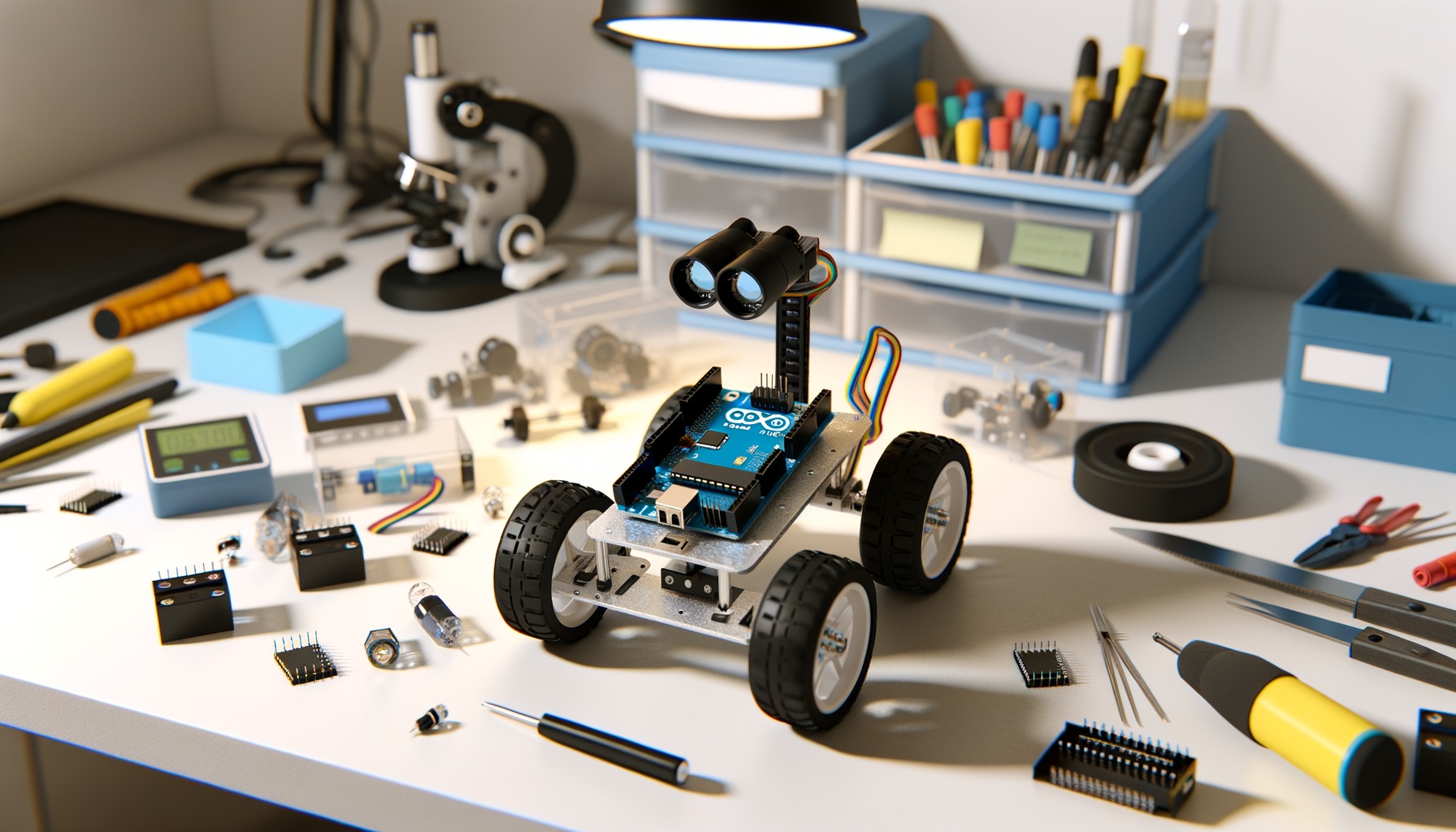
An autonomous or semi-autonomous machine designed to perform tasks automatically
Summary
A robot is a programmable machine capable of carrying out a series of actions autonomously or semi-autonomously, designed to perform tasks that would otherwise require human intervention. Modern robots integrate mechanical engineering, electrical engineering, and computer science to create systems that can sense their environment, process information, and execute physical actions.
The field of robotics has evolved from simple mechanical automata to sophisticated systems incorporating artificial intelligence, machine learning, and advanced sensor technologies. This evolution has enabled robots to perform increasingly complex tasks that were previously impossible.
Robots are characterized by their ability to operate with varying degrees of autonomy, from simple pre-programmed tasks to complex decision-making processes. They typically consist of four core components: sensors for environmental perception, actuators for physical movement, control systems for processing and decision-making, and power supplies for operation.
Today’s robots serve diverse applications across manufacturing, healthcare, agriculture, space exploration, and daily life. This represents a convergence of multiple technological disciplines that continues to shape the future of automation and human-robot interaction.
The robotics industry has experienced unprecedented growth in 2025, with the global robotics market valued at over $150 billion and projected to reach $300 billion by 2030. This growth is driven by advances in artificial intelligence, machine learning, and sensor technologies that have made robots more capable, affordable, and accessible than ever before.
Modern robots can now perform complex tasks such as natural language processing, computer vision, autonomous navigation, and collaborative work with humans. These capabilities represent a significant advancement from earlier generations of robots.
Contemporary robotics applications span from industrial automation and surgical assistance to autonomous vehicles and personal service robots. The integration of large language models and advanced AI systems has enabled robots to understand and respond to natural language commands, learn from minimal examples, and adapt to new situations in real-time.
History
Early Beginnings
The concept of artificial beings dates back to ancient civilizations, with early examples including mechanical automata created by Greek engineers like Hero of Alexandria around 60 AD. These early devices, such as the steam-powered “aeolipile” and mechanical theaters, demonstrated basic principles of automation and mechanical engineering that would later influence modern robotics.
During the Renaissance period, Leonardo da Vinci designed mechanical knights and other automata. His designs showcased advanced understanding of mechanical principles and human anatomy, influencing future robotic development.
In the 18th century, Swiss watchmaker Pierre Jaquet-Droz created sophisticated mechanical figures that could write, draw, and play music. These early automata, though not truly autonomous, established the foundation for understanding mechanical systems and programmable behavior.
Industrial Revolution and Early Automation
The Industrial Revolution marked a significant shift toward mechanization, with the development of automated looms, steam engines, and assembly line systems. This period established the foundation for modern automation concepts.
In 1920, Czech writer Karel Čapek introduced the term “robot” in his play “R.U.R.” (Rossum’s Universal Robots), derived from the Czech word “robota” meaning “forced labor.” This literary introduction popularized the concept of artificial workers and influenced public perception of robotics.
The 1950s and 1960s saw the development of the first programmable machines, including George Devol’s Unimate, the first industrial robot installed at General Motors in 1961. These early robots were large, expensive, and limited to simple repetitive tasks, but they demonstrated the potential for automation in manufacturing.
Modern Robot Development
The 1970s and 1980s brought significant advances in computer technology, enabling more sophisticated robot control systems. The introduction of microprocessors allowed for real-time processing and more complex programming capabilities.
During this period, robots began to incorporate sensors for environmental awareness and started moving beyond simple pre-programmed tasks. This marked a significant shift toward more intelligent and adaptive robotic systems.
The 1990s and 2000s saw the integration of artificial intelligence and machine learning into robotic systems, enabling robots to adapt to changing environments and learn from experience. The development of the Robot Operating System (ROS) in 2007 provided a standardized framework for robot software development, accelerating innovation and collaboration in the robotics community.
Contemporary Robotics (2020-2025)
The current era of robotics has been marked by unprecedented advances in artificial intelligence, machine learning, and human-robot interaction. The integration of large language models and advanced AI systems has enabled robots to understand natural language, learn from minimal examples, and perform complex reasoning tasks.
Collaborative robots (cobots) have become increasingly common in manufacturing, working alongside human workers rather than replacing them. This represents a shift toward human-robot collaboration rather than replacement.
Recent developments include the widespread adoption of autonomous vehicles, advanced surgical robots, and AI-powered service robots in healthcare and hospitality. The robotics industry has also seen significant growth in soft robotics, swarm robotics, and bio-inspired robot designs that mimic natural systems.
Understanding Robot Basics
Simple Definition of a Robot
A robot is fundamentally a machine that can sense, think, and act. Unlike simple machines that perform single functions, robots can perceive their environment through sensors, process this information using control systems, and execute actions through actuators. This three-part capability—sense, think, act—distinguishes robots from other automated systems and enables them to operate with varying degrees of autonomy.
The key characteristic that defines a robot is its programmability. Unlike fixed automation systems, robots can be reprogrammed to perform different tasks, making them flexible and adaptable to changing requirements. This programmability, combined with their ability to interact with their environment, makes robots powerful tools for automation and assistance.
Modern robots integrate advanced technologies including artificial intelligence, machine learning algorithms, and sophisticated sensor fusion systems. These capabilities enable robots to perform complex tasks that were previously impossible, such as natural language processing, computer vision, and autonomous decision-making in dynamic environments.
Key Characteristics of Robots
Robots share several defining characteristics that set them apart from other machines:
Autonomy: Independent Operation Capabilities
Robots can operate independently for extended periods without human intervention, though the degree of autonomy varies significantly. High-level autonomous robots incorporate advanced AI systems that enable them to make complex decisions and adapt to changing conditions in real-time.
Sensing Capability: Environmental Perception Systems
All robots incorporate some form of sensing technology to perceive their environment. Modern robots use multiple sensor types simultaneously—including cameras, LiDAR, ultrasonic, and tactile sensors—to build comprehensive environmental awareness and improve reliability.
Programmability: Flexible Task Adaptation
Unlike fixed automation, robots can be reprogrammed for different tasks. This adaptability allows robots to be modified as requirements change, shifting from simple task sequences to complex behaviors learned through reinforcement or demonstration.
Physical Interaction: Environmental Manipulation
Robots are designed to interact physically with their environment through manipulation or locomotion. This distinguishes them from purely computational systems like standard computers or LLMs.
Common Robot Applications
Industrial and Manufacturing
Industrial robots are the backbone of modern production, specializing in repetitive, high-precision tasks like welding, assembly, and heavy lifting. Operating in controlled environments with micron-level accuracy, these machines—including traditional fixed-arm robots and modern collaborative ‘cobots’—have significantly reduced costs and increased uptime across global manufacturing sectors.
For a deeper look at how these machines are transforming factory floors and the rise of smart manufacturing, see our full guide on Robots in Manufacturing.
Healthcare and Medical
In the medical field, robotics is revolutionizing patient outcomes through high-precision surgical systems, adaptive rehabilitation exoskeletons, and automated laboratory equipment. These machines allow surgeons to perform minimally invasive procedures with tremor-filtering accuracy while providing consistent, data-driven therapy for patients recovering from neurological conditions.
From life-saving surgeries to the future of eldercare assistance, explore the full spectrum of medical technology in our dedicated article on Robots in Healthcare.
Household and Domestic
Domestic robots have transitioned from science fiction to household staples, primarily focused on floor maintenance, lawn care, and hobbyist-grade companionship. In the context of consumer robotics, these machines excel at specific physical tasks—such as a Roomba utilizing LiDAR for SLAM navigation or a pet drone performing automated aerial surveillance—providing homeowners with a tangible bridge into the world of physical AI.
For hobbyists and homeowners, the current state of domestic robotics offers a playground for automation, from simple robot vacuums to sophisticated AI-powered desk companions that can be programmed and customized. For more on home automation, check out our Guide to Robot Vacuums.
Entertainment and Education
Robots play important roles in entertainment, education, and research, making technology accessible and engaging for people of all ages. Educational robots provide hands-on learning experiences that teach students programming, engineering, and problem-solving skills through tangible projects. Students can see immediate results from their programming efforts, which helps maintain motivation and interest in STEM subjects.
Robot History and Evolution
The history of robotics begins with ancient mechanical devices designed to mimic life. From Hero of Alexandria’s mechanical theaters in 60 AD to Leonardo da Vinci’s mechanical knights, the dream of artificial beings has driven engineering innovation for centuries.
The modern era began with the first industrial robot, George Devol’s Unimate, installed at General Motors in 1961. Today, we are witnessing the convergence of physical machinery with Artificial General Intelligence (AGI), leading to robots that can understand context and perform complex reasoning tasks previously reserved for humans.
Getting Started with Robotics
For beginners, the sense-think-act loop is the most important concept to master. Understanding how sensors gather data, microcontrollers process logic, and actuators create movement is the foundation for any build.
If you’re ready to start your journey, follow our Robotics for Beginners Learning Roadmap to go from absolute zero to building your first autonomous machine.