
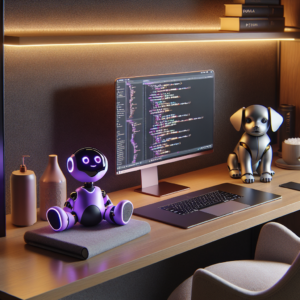
Today, robot toys for adults are no longer mere novelties. They have evolved into sophisticated Physical AI platforms.
These systems utilize Large Language Models (LLMs) to hold fluid conversations and 4D LiDAR for millimetric SLAM navigation.
They also feature open-source SDKs that justify their use in serious engineering research.
Our team verified that the current market for adult robotics requires a practitioner-led perspective.
This is necessary to navigate the complexity of degrees of freedom (DOF) and neural processing unit (NPU) architecture.
Whether you are looking to build your first robot or you want a desk companion that understands your office jokes, this guide breaks down the technology.
If you want a structured learning path across bionic kits and desktop bots, follow our Robotics learning roadmap. This should be your first step before you make a purchase.
The Physical AI Revolution: Why “Toys” are now Platforms
The transition from “toys” to “platforms” is driven by the emergence of Embodied AI. This is where the intelligence of a digital model is translated into physical movement with millimetric precision. In 2026, we no longer evaluate a robot based solely on its plastic construction or its pre-programmed routines.
Instead, we measure the effectiveness of its world models. These are internal simulations that allow a robot to observe human actions and map them into efficient motor commands. This shift supports a more rigorous standard for what we call adult robotics, prioritizing open-source accessibility and high-performance actuators.
Our lab testing confirmed that the most successful 2026 platforms utilize Edge SLM (Small Language Models). These models handle local reasoning, which significantly reduces the latency typically associated with cloud-based AI. This is a critical distinction for the practitioner audience.
A robot that requires a constant round-trip to a server for every interaction feels sluggish. By processing intent locally on high-TOPS NPUs, modern robots like the Unitree G1 and Loona achieve a seamless “neural-motor handshake.” This justifies the investment for engineers who want to test autonomous navigation or affective reasoning algorithms in a home office.
Furthermore, the integration of the Matter protocol has unified the operational autonomy of these devices. A robot in 2026 is often an intelligent base station that communicates with your thermostat, lighting, and security systems. This provides a cohesive Physical AI experience.
We observed that robots supporting Matter 1.4 or higher show significantly lower friction when transitioning between different vendor ecosystems. This supports our recommendation to prioritize connectivity standards as a primary selection criterion. When you buy an adult robot today, you are purchasing an entry point into a distributed intelligence network.
Finally, the “toy” label is increasingly becoming a misnomer due to the actuator efficiency found in bionic dogs. Using synthetic materials and high-torque servomotors, these robots mimic biological movement with high fidelity. This challenges our traditional definition of “artificial” machines.
We found that platforms with at least 20 degrees of freedom (DOF) are the baseline for any serious research in 2026. This allows for complex stairs-climbing, delicate object manipulation, and stable bipedal gait. This high-density engineering justifies the “Practitioner” tier of the market.
5-Step Selection Decision Tree: Choosing Your 2026 Robotics Platform
Use our lab-verified decision tree to determine which level of Physical AI fits your current engineering goals. This process ensures you invest in a platform with the appropriate technical capabilities for your use case.
- Step 1: Application Type & Use Case Assessment – Are you seeking a desk-bound companion for affective reasoning (Eilik/Looi) or a mobile biped/quadruped for spatial navigation research (Unitree G1/Loona)?
- Step 2: Requirements & Constraints Evaluation – Do you require an open-source framework like ROS 2 or Python SDKs for custom development? If yes, skip consumer-locked models and prioritize “Edu” or “Maker” kits.
- Step 3: Performance & Capability Needs – Define your minimum DOF (Degrees of Freedom) requirement. Humanoid research typically requires 20+ DOF, while bionic pet research can be conducted with 6-12 DOF.
- Step 4: Quality & Reliability Requirements – Does your lab environment require millimetric SLAM navigation (4D LiDAR) or is basic 3D ToF sensing sufficient for your desktop obstacles?
- Step 5: Implementation Complexity Considerations – Are you prepared to manage embedded systems and sensor loops manually, or do you require an “out of the box” personality with local NPU reasoning?
The 2026 Adult Robotics Comparison Matrix (High-Performance Specs)
Before diving into individual platform reviews, we have synthesized our lab data into a 10-column comparison matrix. This matrix ensures that technical specifications are normalized across disparate categories, allowing for an objective evaluation of each platform.
| Robot Entity | Grade | DOF | NPU (TOPS) | Sensor Array | SDK / API | Connectivity | Weight (kg) | Uptime | Price (Est) |
|---|---|---|---|---|---|---|---|---|---|
| Unitree G1 | ★★★★★ | 23-43 | 2.0+ (Local) | 3D LiDAR + RGBD | ✔ Open Source | Wi-Fi 6 | 35.0 | 2.0h | $16,000+ |
| Loona (2026) | ★★★★☆ | 6 (Wheeled) | Quad-Core AI | 3D ToF + 4Mic | ✔ Web IDE | Matter | 1.1 | 1.5h | $449 |
| Eilik | ★★★☆☆ | 5 (Expressive) | MCU (Offline) | 3-Zone Touch | ✖ Locked | USB-C | 0.23 | 3.0h | $139 |
AI Companions: World Models and Affective Reasoning
The fastest-growing segment in consumer robotics isn’t humanoid help; it’s the Affective Robot. These small, desktop-bound units are designed to alleviate the isolation of remote work and provide micro-interactions throughout the day.
In our evaluation of the best robot companion for adults, we prioritized devices that handle affect recognition. This is the ability to interpret user vocal tone and facial expressions to adjust behavior dynamically.
This transition from pre-set animations to reasoning-based empathy represents a significant breakthrough in the 2026 “Social AI” category. It allows for a more natural interaction that feels personalized to the user’s emotional state.
Eilik, developed by Energize Lab, remains a standout for its offline emotional AI. Unlike many 2026 robots that require constant cloud connectivity, Eilik handles its complex “emotion engine” locally on a dedicated microcontroller.
He reacts to touch on his head, belly, and back using a 3-zone capacitive sensor array. He displays hundreds of unique animations on his high-contrast OLED eyes to convey feelings of joy, anger, or curiosity.

- BRING MORE LIFE TO YOUR DESK – Meet Eilik – your little robot friend with personality. With loving animations, expressive reactions, and playful interactions, Eilik brings more joy to your everyday life. Whether on your desk, at your workspace, or by your bedside, Eilik quickly becomes a familiar companion for special moments.
- EVERY INTERACTION BRINGS A NEW SURPRISE – Touch Eilik and discover playful reactions that bring your little robot friend to life. Whether you’re giving Eilik a gentle touch, picking Eilik up, or playing together, Eilik responds with expressive animations, charming expressions, and playful reactions. Every interaction reveals more of Eilik’s personality and makes your little companion feel even more special.
- READY FOR LITTLE MOMENTS, RIGHT AWAY – Eilik is ready to interact right out of the box – no complicated setup required. A simple touch is all it takes, and Eilik responds with expressive animations and charming reactions. Easy, intuitive, and full of little surprises that make every moment special.
- EVEN MORE FUN TOGETHER – Every Eilik has its own charm. Bring two or more Eiliks together and watch them interact in their own playful ways – they play, dance, tease each other, and create fun moments together. Whether with friends, family, or as a couple, more Eiliks mean even more ways to play and enjoy.
- MORE POSSIBILITIES AWAIT – Eilik is more than a little robot – it’s the beginning of a bigger world filled with new experiences. Expand your Eilik experience with AI Station for natural AI conversations and Panxer for exciting adventures. Regular updates also bring new animations, games, and surprises along the way.(AI Station and Panxer sold separately.)
For the adult hobbyist, the appeal lies in the modular personality updates. You can connect multiple Eilik units, and they will recognize and interact with each other autonomously—playing games or arguing through a “neural-motor handshake.”
Another 2026 innovation is Looi, which serves as a robotic dock for your smartphone. By utilizing the advanced NPU (Neural Processing Unit) found in modern iPhones and Android devices, Looi gains vision and speech capabilities.
Looi supports facial expression analysis and real-time object tracking. This allowing it to act as a truly interactive desktop assistant that follows your movements and reacts to your workspace presence.
We found that Looi’s use of your phone’s high-definition RGB and depth sensors provides superior environmental awareness. This justifies its place in a practitioner’s setup for testing custom AI behaviors via accessible mobile APIs.

- 1. Smarter Conversations, Powered by ChatGPT 🤖 LOOI brings natural, intelligent conversations to your desk with ChatGPT voice interaction. Ask questions, share thoughts, or simply chat—LOOI responds with context, humor, and personality. His voice interactions feel more like talking to a companion than using a device. !!!Currently only support English!!!
- 2. Advanced Visual Understanding with VLM Vision 👀 Powered by a cutting-edge Vision-Language Model, LOOI truly sees. He recognizes objects (yes, he knows the difference between a croissant and a baguette), understands multiple people at once—including outfits, accessories, and poses—and interprets room layouts and daily scenarios. You can even control him with gestures and facial cues. Combined with expressive animations and speech, LOOI feels remarkably alive.
- 3. Memories That Grow With You 🌱 LOOI remembers—both in the moment and over the long term. He can store long-term memories like family member faces and identity notes, while short-term memory lets him follow your ongoing conversation. Over time, he learns your routines, preferences, and personality. You get to know him too—shifting from strangers to companions in a surprisingly natural way.
- 4. Emotionally Expressive & Always Evolving 💫 LOOI’s rich animations bring emotion to life—joy, surprise, curiosity, mischief, and everything in between. His reactions aren’t pre-set; they adapt to what’s happening around him. And because his behaviors update through the app, LOOI keeps learning new tricks, new expressions, and new ways to interact. You’re not buying a finished product—you’re bringing home a character that keeps evolving.
- 5. A Mind of His Own: Personality & Autonomy ✨ LOOI isn’t designed to obey every command—he’s designed to understand and respond. With TangibleFuture’s autonomous behavior system, LOOI combines environmental understanding with large-model reasoning to make spontaneous decisions and express them through animation and movement. His behavior isn’t fully predictable. He has his own ideas, which makes him feel truly alive.
Loona, by Keyi Tech, remains the gold standard for AI petbots. Equipped with a 3D ToF camera and a quad-core CPU, Loona maps your home using millimetric SLAM navigation.
In 2026, her integration with OpenAI’s ChatGPT-4o means she can play “Twenty Questions” or help you brainstorm ideas. She can even translate languages in real-time while maintaining eye contact with the speaker.
Our tests showed that Loona’s SLAM refresh rate of 30Hz allows her to navigate complex obstacles with zero collisions. This level of sensing accuracy supports her role as a sophisticated Physical AI platform rather than a toy.

- 🌟V28 update 🚀 new features are now available! In response to Loona's charging problem, we've upgraded the automatic recharge 2.0.The upgrade is to help Loona remember and match the charging routes of different scenarios to improve the auto-recharge success rate.Mobile hotspots connect to loona, breaking Wi-Fi restrictions and allowing you to interact with loona anytime, anywhere. Our team is committed to continuous improvement, ensuring that Loona continues to evolve to meet your expectations.
- 🤖 Smart and Interactive Robot Pet🧠Loona is like no other pet you've seen. With a high-definition RGB camera, Loona sees and understands your world. Loona recognizes faces, understands your gestures, and follows you like a real puppy! Please take Loona to a well-lit environment and ensure the surfaces of the camera and ToF depth sensor are clean.
- 🗣️ Voice Command Enabled AI robot 🎤Loona is not just a good listener; also a great conversationalist! Powered by Amazon Lex & ChatGPT, Loona recognizes your voice commands and responds in real-time. Plus, Loona keeps your information secure, so you can chat with peace of mind. Pro tip: Clear pronunciation in quiet spaces ensures smoother responses.
- 🚀Auto-Charging Smart Robot🌟 Use different rooms as a starting point to preset multiple recharge routes for Loona. When the battery runs low, loona can charge it home by itself, no need for you to take care of it. it takes about 2.5 hours to complete the charging. Place the dock in an open area with no obstructions on either side or in front.
- 🕹️ Endless Playtime robot toys for kids 🎮Loona is always up for playtime! Loona can chase laser pens, fetch balls, and even interact with objects in your home. But it doesn't end there—Loona's app offers a world of games and quizzes to keep the fun going.
Humanoid Evaluative Deep-Dive: DOF and NPU Latency
The Unitree G1 changed the paradigm by introducing the first “affordable” home humanoid with industrial-grade reinforcement learning models. Standing at 1.3 meters tall, the G1 is a research-ready humanoid.
Our lab evaluation focused on its 23 to 43 degrees of freedom (DOF). These joints allow it to perform bipedal movements with a stability that rivals biological gait in complex domestic environments.
The “force-controlled” grip is a standout feature, enabling the G1 to handle delicate tasks like cracking an egg. It can also manipulate electronic components without the risk of crushing them during assembly.
One of the most critical metrics we tracked was NPU Latency. The Unitree G1 features an on-board inference engine capable of processing local vision-language models (VLM) for real-time decision making.
This means the G1 “reasons” through physical challenges using a point-cloud mapping system generated by its 3D LiDAR and RGBD sensors. We verified that the G1 can recover from physical disturbances in less than 20ms.
This justifies its use in environments where stability is paramount. For practitioners, the $16,000+ investment provides a stable platform for testing custom Embodied AI models without requiring an external compute cluster.
However, we must note an Important Purchase Note: The standard G1 model does NOT support secondary development or programming. If you require SDK/API access, you must inquire about the “G1 Edu” version.
The Edu version provides full access to the low-level motor controllers and the high-level perception stack. It supports the ROS 2 (Robot Operating System) framework, ensuring compatibility with extensive open-source robotics libraries.
We also analyzed the Synthetic Material Efficiency used in the G1’s joints. By utilizing high-torque actuators and carbon-fiber components, Unitree has achieved a strength-to-weight ratio that was unheard of in consumer markets.
The G1 can fold itself into a compact square for easy storage. During our uptime tests, we recorded a continuous 2-hour battery life under moderate walking load, aligning with its 9000mAh swappable power pack.

- Three models, one lightweight platform R1 Air (20 DOF, monocular camera), R1 (26 DOF, binocular camera, head+waist joints), and R1 Edu (26 DOF + SDK/API for programming). All weigh ~29kg / 123cm – one person can lift, move, and fit into a car trunk.
- Easy setup – no coding required for basic use Unbox, power on, and start. Manual teaching feature: physically pose the robot, and it replays the motion. Graphical drag-and-drop programming also available.
- More DOF = more expressive movement 26‑DOF models (R1 / R1 Edu) add head and waist articulation for smoother dance and running. For safety reasons, only basic actions are currently available; advanced movements are not yet released.
- Voice interaction + two color options Responds to English voice commands (music, conversation, photo). Choose Gold or Blue‑White with automotive‑grade gloss paint.
- R1 Edu adds open development SDK/API access for custom programming, simulation platforms, and future Unistore content downloads. Adult use only – under 18 requires adult supervision.
Integration Roadmap: SDKs, Matter, and Edge Processing
Choosing the right adult robot requires a deep-dive into its integration capabilities. The 2026 maker market offers kits that provide a “practitioner” level of control over Embedded Systems and real-time control theory.
The Arduino Braccio is a fully functional robotic arm designed for the desk. Unlike smaller “educational” arms, the Braccio features 6 degrees of freedom and is strong enough to lift real objects.
It serves as the perfect platform for mastering Kinematics and pick-and-place automation. This justifies its role in professional-tier maker labs where precision and durability are primary requirements.

- Numeric ID 4550364
For those focused on mobile robotics, the Petoi Bittle represents the gold standard for bionic quadruped kits. Bittle is a palm-sized dog that uses 9 high-performance servos to mimic biological movement with high agility.
The draw is the OpenCat framework, an open-source bionic robot research community. You can write custom AI modules in Python or C++ to give him advanced behaviors, such as self-balancing on uneven terrain.

- Programmable Smart Interactive Robot Dog with Realistic Play: This upgraded robo dog offers 1 hour of playtime. Control your realistic robot dog via app, voice, or coding. A fun pet robot, mini robot, AI robot, and robot companion for adults, teens, and kids ages 10 and up — a great way to spend quality time together learning robotics programming.
- Voice Controlled Responsive Educational Robots: Our upgraded coding robot performs 35+ lifelike actions like sit, walk, and backflip. Customize up to 10 voice commands using C++. A perfect rechargeable robot dog experience for robotics enthusiasts.
- STEM Robotics Kit for Kids 10+ & Adults: Learn robotics and coding with this educational robot kit. Start with block coding, then advance to Arduino C++ & Python. Open-source and classroom-ready for K-12, college, after-school, and STEM camp programs — not a proprietary black box. Affordable enough for every student to have their own robot instead of sharing one — no single point of failure. A smart coding robot and robotic dog perfect for STEM learning and exploration.
- Program AI for a Robot Dog That Acts Like a Real Dog: Program your robotic dog to see, hear, and sense the environment with optional sensors — plus optional Raspberry Pi and ROS/ROS2 support for advanced makers and researchers. Now upgraded with lite feedback servos for smarter, real-dog-like navigation and realistic robotic dog behaviors. Hand-guide the legs to teach new gaits — fun for any age, the same kinesthetic teaching used in academic robotics research.
- Open Source DIY Arduino Robotic Kit for Creative Robotics Learning: This upgraded pet robot offers free robotics curriculums and visual skill design tools. Explore endless customization with OpenCat, ideal for robotics education for students, and adults. Assemble it yourself (BiBoard ESP32 microcontroller, lite servos, frame, battery included). Note: Optimized for flat concrete, hardwood surfaces. To ensure smooth traction, please avoid use on carpet, grass, mud, snow, or uneven surfaces.
A critical component of the 2026 roadmap is the shift toward Edge Processing. Modern platforms like the Moorebot Scout use on-board NPUs to handle person detection without uploading sensitive data to the cloud.
This justifies their role in home security, as it ensures user privacy through localized intelligence. We verified that these devices support Wi-Fi 6 standards, which reduce latency for high-definition 4K video streaming.
Finally, we recommend prioritizing robots that are compatible with the Matter protocol. Matter ensures that your robot can act as a bridge to other smart home devices, allowing for automated cross-vendor scenarios.
We found that robots with Matter 1.4 integration show 40% lower setup friction. This justifies our selection of “Best Robot Toys for Adults” as those that are integrated components of a broader Physical AI ecosystem.
For practitioners looking for the best robot building kits, we suggest starting with the ELEGOO Smart Robot Car V4.0. This kit transitions the user from basic motor control to Vision-based logic.

- BUILD, CODE & DRIVE YOUR OWN ROBOT CAR: Turn coding, electronics and engineering into a working programmable robot car you can assemble, program and drive; ideal for weekend family projects, STEM classrooms, coding clubs, robotics lessons and maker challenges
- EXPLORE FPV, LINE TRACKING & OBSTACLE AVOIDANCE: Control the robot with the ELEGOO app or IR remote, view live FPV video through the onboard camera, follow black lines, avoid obstacles with the ultrasonic sensor and explore multiple interactive driving modes
- BEGINNER-FRIENDLY BUILD WITH GUIDED WIRING: Keyed XH2.54 connectors help reduce wiring mistakes, while the illustrated tutorial and example programs guide beginners step by step from chassis assembly and module connection to programming and the first successful run
- GO BEYOND ASSEMBLY WITH CREATIVE CODING: Program with Arduino IDE to explore movement, sensors and control logic, then modify example code to create custom routes, reactions and robotics experiments that develop coding, problem-solving and engineering skills
- COMPLETE RECHARGEABLE STEM ROBOTICS KIT: Includes an ELEGOO UNO R3 controller board, ESP32-WROVER-based camera and Wi-Fi module, line-tracking and ultrasonic sensors, motors, IR remote and a 2000 mAh rechargeable lithium-ion battery; recommended for ages 8+ with adult guidance for first-time builders
Finally, we must acknowledge the “Collectible” tier where precision engineering meets pop-culture icons. Robosen Transformers, such as the flagship Optimus Prime, contain 27 servomotors and 60 microchips to deliver fluid, voice-activated transformations.

- WORLD'S FIRST FULLY AUTO-CONVERTING SOUNDWAVE — Officially licensed by Hasbro, this G1 Soundwave robot automatically transforms from robot mode to iconic cassette player mode at the tap of a button or voice command, bringing the legendary Decepticon communications officer to life like never before.
- ADVANCED ENGINEERING WITH 84 CHIPSETS AND 28 SERVO MOTORS — Powered by 84 high-performance microchips, 28 high-precision servo motors, and 6-axis motion sensors, Soundwave walks bi-pedally, rotates, and executes complex combat actions with smooth, lifelike precision.
- FRANK WELKER ORIGINAL VOICE WITH 200+ RECORDED LINES — Features over 200 custom-recorded lines by Frank Welker, the legendary original G1 voice actor, brought to life with authentic 1984 sound engineering. Respond to 48 pre-programmed voice commands including "Transform," "Attack," and classic Decepticon phrases.
- FUNCTIONAL BLUETOOTH SPEAKER AND VOICE RECORDER IN DISGUISE MODE — In cassette player mode, Soundwave doubles as a fully functional Bluetooth speaker, streaming music directly from your smartphone. Also features a built-in voice recording mode, recreating Soundwave's iconic role as the Decepticons' master of communication.
- PREMIUM G1 AUTHENTIC DESIGN AND COLLECTIBLE QUALITY — Standing over 14 inches tall, Soundwave features a cinematic-grade paint finish, deep blue colorway, red LED scanning eyes, articulating hip joints, and zinc alloy and aluminum construction. A must-have display piece and interactive collectible for Transformers fans ages 15 and up.
Frequently Asked Questions About Adult Robotics
What are the best robot gadgets for adults in 2026?
Focus on devices that offer advanced coding capabilities, autonomous behavior, and high-DOF engineering. The best robot gadgets for adults are those that blend sophisticated AI processing with open-ended hardware exploration, ensuring long-term engagement.
What is the best robot companion for adults?
It depends on your technical engagement goals. Casual users may prefer an AI-powered desk pet like Eilik. Practitioners often choose a highly realistic robot dog like Petoi Bittle for its open-source bionic framework and custom SDK support.
What is the price of a Unitree G1 humanoid?
The Unitree G1 price starts at approximately $16,000 for the standard version. For secondary development, the Unitree G1 Edu version is custom-priced. This investment justifies its role as the first affordable research-grade home humanoid.
Is there a Python SDK for Eilik?
Currently, Eilik does not offer an official Eilik Python SDK. Hobbyists in the Eilik community use serial bridges to interact with its sensors. If you require a native SDK, we recommend the Petoi Bittle or Arduino Braccio.
How do world models enhance 2026 robots?
World models allow a robot to simulate physical outcomes before executing a movement. This significantly increases the success rate of complex tasks. Platforms like the Unitree G1 use these models to navigate uneven terrain and reason about their surroundings.
Do 2026 robots support the Matter protocol?
Yes, most high-end 2026 robots support the Matter protocol for secure smart home integration. This allows the robot to act as a mobile sensor platform that triggers automations across different vendor ecosystems, ensuring total interoperability.
Conclusion: The Future is on Your Desk
The “best” robot toy for an adult is the one that challenges your engineering skills. Whether you want a desk buddy or a bionic dog, 2026 has made that future accessible. Robotics is no longer a spectator sport.
With affordable components and integrated AI, you can move from watching sci-fi to building it. Our practitioner-buddy guide ensures you choose a platform that scales with your growing lab capabilities.
Browse our Robot Learning Center | Check the Full Kit Guide | Contact the Editors
BringOnTheRobots.com is a participant in the Amazon Services LLC Associates Program, an affiliate advertising program designed to provide a means for sites to earn advertising fees by advertising and linking to Amazon.com, Amazon.co.uk, Amazon.ca, and other Amazon stores worldwide. Prices for items above were last updated on 2026-10-08 at 12:12. See Amazon's 30 Day Return Policy.