
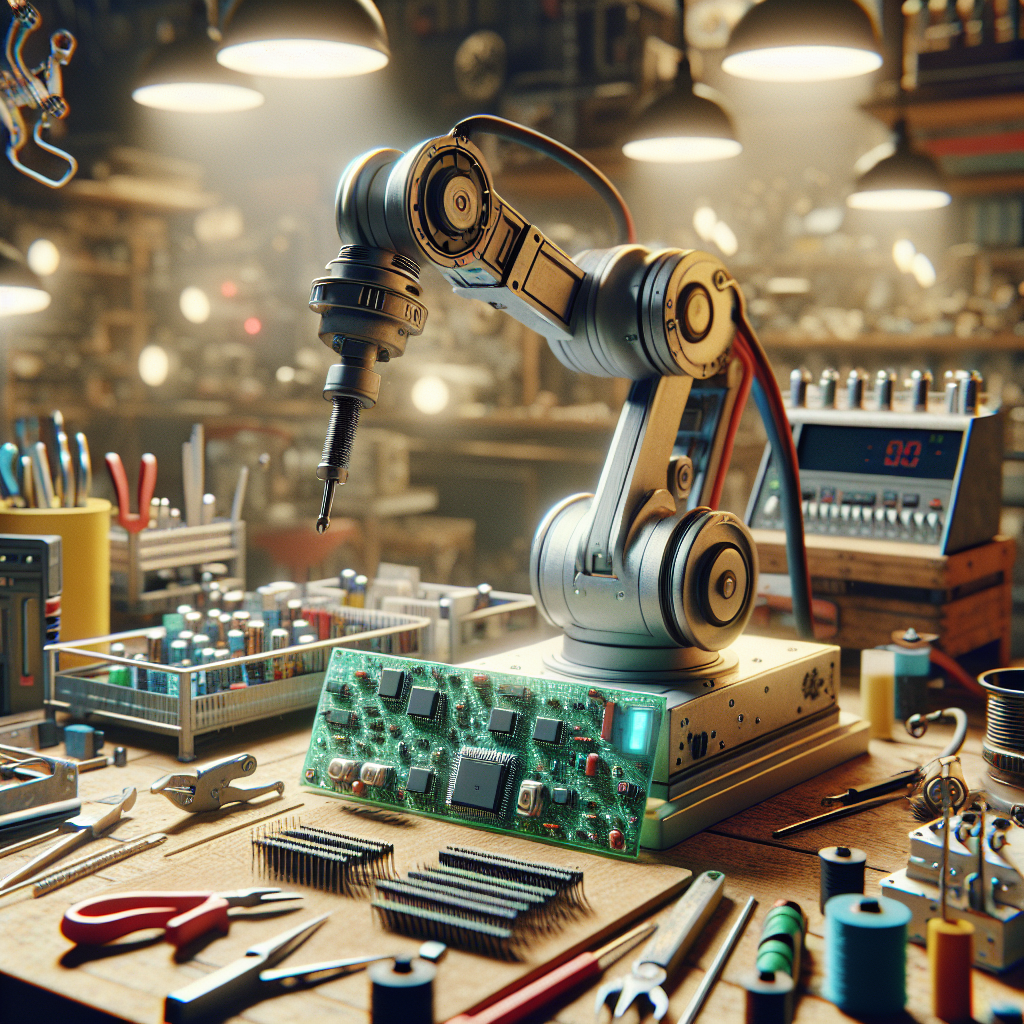
When Boston Dynamics Atlas does a backflip or a warehouse robot picks up an object it's never seen before, that's AI in robotics—not pre-programmed motion. How robots use AI is different from ChatGPT: it's about physical intelligence, spatial reasoning, and real-time decision-making in unpredictable environments. This guide explains how artificial intelligence robots actually work—the journey from classical programming to machine learning robotics, computer vision, and foundation models—and what's possible today versus what's still aspiration. You'll see how how robots learn ties into perception, control, and the hardware that runs robot AI on the device. In the how robots work framework, AI sits in the “think” step: it turns sensor data into decisions and then into motion.
AI in Robotics vs AI in Software
Physical Intelligence vs Digital Intelligence
Chatbots and language models process text and generate text. Robot AI processes sensor data—images, LiDAR, force, joint angles—and outputs physical actions: wheel speeds, joint torques, gripper open/close. Latency matters in milliseconds: a robot that waits for the cloud to decide will fall over or collide. So robot AI explained has to include where computation runs (on-device vs cloud), how fast the perception pipeline and motion planning run, and why safety stakes are physical—a wrong move can break hardware or harm people. Smart robots and intelligent robots in the real world need real-time decision making and robust perception, not just clever text.
Why Robotics AI Is Harder
The real world is messy, unpredictable, and continuous. There are no discrete tokens like in language; physics doesn't pause. Every action has consequences—often irreversible. So how do robots use artificial intelligence to make decisions? They combine learned models (e.g. neural networks for vision or policy) with classical safety and control. Robotics and AI research at Google DeepMind, OpenAI, and Boston Dynamics focuses on making agents that generalize to new scenes and objects, handle uncertainty, and run reliably on robot hardware. It's harder than training a chatbot because the cost of failure is physical.
Classical Programming vs AI-Driven Behavior
Rule-Based Control
Rule-based control—if/then logic, state machines, and behavior trees—works well in structured environments. Factory robots that weld the same seam every time don't need machine learning; they need precise trajectories and safety limits. Many industrial systems still use no ML at all. But in unstructured environments (a cluttered kitchen, a busy warehouse, outdoors), hand-coding every scenario is impossible. That's where AI robot technology steps in.
The Shift to Learning
Machine learning lets robots handle situations the programmer never anticipated. Instead of scripting “if obstacle left, turn right,” you train a policy or vision model on data (or in simulation) so the robot generalizes. How do robots learn to do new tasks without being programmed? Through supervised learning (labeled data), reinforcement learning (trial and error with rewards), or imitation learning (watching humans). The shift from classical to learning-based control is what makes modern robot AI different from the robots of 20 years ago.
How Robots Use Computer Vision
Object Detection and Recognition
Computer vision turns pixels into actionable information. Object detection (e.g. YOLO, SSD) lets a robot find and classify objects in an image—used in picking and sorting, obstacle identification, and face recognition. Convolutional neural network (CNN)s are the backbone; OpenCV and frameworks like TensorFlow and PyTorch are standard for training and deployment. Robots use this for “what is that and where is it?”—essential for manipulation and navigation. Our guide to robot sensors covers the camera hardware; here we focus on the AI that interprets the images. How do robots use computer vision to recognize objects? By running trained models (often on NVIDIA Jetson or similar edge hardware) on each frame and feeding the results into planning and control.
Visual SLAM and Spatial Understanding
Visual SLAM (simultaneous localization and mapping) builds a 3D map of the environment from camera data while estimating the robot's pose. Algorithms like ORB-SLAM and visual odometry are used in navigation, autonomous driving, and drone flight. SLAM gives the robot a spatial understanding—”where am I and what does the world look like?”—which is then used for path planning and collision avoidance. It's a key part of robot perception in unstructured spaces.
Semantic Understanding
Semantic segmentation labels every pixel with a class (road, person, furniture), so the robot understands not just “what” but “where” and “how to interact.” This is an emerging capability: understanding scenes in a human-like way so that high-level instructions (“pick up the red cup”) can be turned into motion. Robot foundation models and large language model (LLM)s are starting to bring this kind of reasoning into physical robots. Transformer models and vision-language models (e.g. RT-2) combine camera input and language to produce action sequences—bridging the gap between “see” and “do.”
Machine Learning Approaches in Robotics
Supervised Learning
Supervised learning uses labeled data—e.g. images with bounding boxes or joint angles for a given task. It's used for object classification, gesture recognition, and quality inspection. The robot learns a mapping from input (image, sensor stream) to output (label, action). It requires lots of curated training data but is well-understood and deployable. Many industrial vision systems rely on supervised deep learning models.
Reinforcement Learning
Reinforcement learning (RL) learns by trial and error: the robot tries actions, gets rewards or penalties, and updates its policy to maximize cumulative reward. What is reinforcement learning? It's the approach behind teaching robots to walk (e.g. Boston Dynamics, Google DeepMind), grasp novel objects, and play games. RL can handle complex, high-dimensional control but needs many trials—often in simulation—and careful reward design. Algorithms range from classic Q-learning to modern actor-critic and model-based RL. IEEE Spectrum and The Robot Report cover RL in robotics regularly.
Imitation Learning
Imitation learning learns from human demonstrations: the robot watches a human do the task (or follows teleoperation) and learns to mimic the behavior. It's used for manipulation, surgical procedures, and humanoid motion. Can robots learn by watching humans? Yes—imitation learning often needs less data than pure RL and can bootstrap policies that are then refined with RL or in the real world. Google and Stanford are among the leaders in this research.
Sim-to-Real Transfer
Training in Simulation
Training a physical robot is slow, expensive, and risky. Physics simulators—Isaac Sim, MuJoCo, Gazebo—let robots practice millions of times in software. Sim-to-real transfer is the art of making behaviors learned in simulation work on the real robot. Domain randomization (varying textures, lighting, physics parameters) helps bridge the “reality gap.” NVIDIA Isaac and Isaac Lab are widely used for this. What is sim-to-real transfer? It's taking a policy or model trained in simulation and deploying it on the real robot, often with fine-tuning or adaptation.
Why This Matters
Simulation is fast, cheap, and safe. Real-world data is scarce and costly. So the pipeline is: train in sim, validate in sim, then transfer to real with minimal real-world tuning. This has enabled much of the progress in legged locomotion and manipulation—Tesla Optimus and Figure AI use simulation heavily. The combination of better simulators and better transfer methods is a major driver of how robots learn complex behaviors. How does machine learning make robots smarter over time? By training on more data (from sim or real world), refining rewards and objectives, and scaling up model size and compute—so the same architecture gets better at generalization and robustness.
Foundation Models and LLMs in Robotics
Robot Foundation Models
Robot foundation models are trained on diverse robot data so they generalize to new tasks and environments. Google DeepMind's RT-2 and RT-X are examples: vision-language-action models that can follow natural language instructions and perform novel tasks. The “GPT moment” for robotics—general-purpose models that adapt to many tasks—is approaching. These models turn high-level commands into low-level actions by leveraging internet-scale language and image knowledge.
LLMs as Robot Brains
LLMs (e.g. ChatGPT, Google Gemini) are being integrated into robots for task understanding and planning. Figure AI uses LLMs so robots can follow natural language instructions and reason about multi-step tasks. The idea: the LLM handles “what to do” and “why,” while traditional control handles “how” to move. How is ChatGPT-style AI used in robots? As a high-level planner and interpreter of human intent; the robot then executes with its own perception and control stack. This split keeps real-time safety-critical loops (e.g. balance, collision avoidance) in deterministic code while letting the LLM handle open-vocabulary understanding and task decomposition.
Current Limitations
Hallucination in physical context is dangerous—a robot that “imagines” an obstacle or misinterprets a command can cause harm. Latency and compute are real constraints: running large models on-device is still limited, so the heaviest reasoning often stays in the cloud for non-real-time tasks. We're far from general-purpose robot intelligence; today's systems are narrow but impressive within their scope. Will robots with AI eventually become sentient? Current AI is narrow—excellent at specific tasks but with no general understanding or consciousness; sentience is not on any realistic roadmap. Research focuses on making robots more capable and safe within clearly defined domains, not on creating consciousness.
Edge AI — Intelligence on the Robot
On-Device vs Cloud Processing
Real-time control can't wait for the cloud. Edge AI and on-device inference run the neural network on the robot—on NVIDIA Jetson (Orin, AGX), Coral Edge TPU, or Intel Movidius. Low latency is critical for stability and safety. On-device also helps with privacy and reliability when the network is poor. Small consumer robots such as the Anki Cozmo line run lightweight on-device models for face recognition and expression; industrial and research robots run heavier stacks (vision, SLAM, policy) on Jetson or similar. The trend is to push more of the perception and even policy inference to the edge as hardware improves, while using the cloud for training and for non-real-time reasoning (e.g. language understanding, long-horizon planning).
The Tradeoff
More powerful models need more compute; edge devices are power- and size-limited. So there's a constant tradeoff: simpler models for fast, cheap edge vs. larger models for accuracy, often with cloud assist for non-real-time tasks. The sweet spot is shifting as hardware improves—Jetson Orin and next-gen NPUs are making larger models feasible on the robot.
Where Robot AI Is Today — and Where It's Going
What AI Can Do Now
Today's AI in robotics delivers: reliable navigation (SLAM, path planning), object picking (bin picking, sortation), visual inspection, basic manipulation (pick-place, simple assembly), and autonomous driving on highways. These are deployed in warehouses, factories, and hospitals—surgical navigation, rehab devices, and logistics AMRs all lean on similar perception-and-planning stacks, even when the domain changes. Do all robots use AI? No—many industrial robots still use classical programming with no ML; but AI adoption is accelerating, especially for robots in unstructured environments.
What's Still Hard
Dexterous manipulation (e.g. tying shoelaces, folding clothes), unstructured outdoor navigation, robust social interaction, and broad generalization across tasks are still hard. Common-sense reasoning—”if the drawer is stuck, try pulling harder or wiggling”—is limited. So is long-horizon planning: a robot that can do 10 steps in a row might fail on step 11 when the world doesn't match expectations. These are active research areas at Amazon Science, academic labs, and startups. Do robots have neural networks like human brains? They use artificial neural networks (ANNs) for perception and policy—inspired by biology but not the same; there's no evidence robots have consciousness or feeling.
The Next Five Years
Foundation models and LLMs will enable robots that learn new tasks from language instructions with minimal demonstration. Humanoid robots will become viable for simple household and logistics tasks. The gap between research demo and reliable deployment will shrink as sim-to-real and data efficiency improve. How robots think will increasingly look like a mix of learned perception, learned policy, and symbolic or language-based planning. Natural language processing on the robot will let users give commands in plain language instead of code or teach pendants. Frameworks like ROS 2 will continue to integrate with ML stacks (TensorFlow, PyTorch) so that perception, planning, and control run in a unified pipeline—with edge AI handling the real-time loop and cloud or larger models assisting where latency allows.
FAQ
Can robots actually think?
Not in the human sense. They process data and make decisions based on algorithms and learned patterns, but they have no consciousness or understanding. Robot AI is sophisticated pattern matching and optimization, not subjective experience.
How is AI in robots different from ChatGPT?
How is AI in robots different from ChatGPT? ChatGPT processes text in and text out; robot AI processes sensor data and outputs physical actions in real time. The challenges—latency, safety, uncertainty, embodiment—are fundamentally different. Robotics AI has to close the loop in the physical world.
Do all robots use AI?
No. Many industrial robots use classical programming with no machine learning. But AI adoption is accelerating, especially for robots that operate in unstructured or changing environments—warehouses, homes, outdoors.
What is reinforcement learning?
A machine learning approach where the robot learns by trial and error, receiving rewards for good actions and penalties for bad ones—similar in spirit to training a dog. It's used for locomotion, manipulation, and game-playing and often relies on simulation for enough trials.
Can robots learn by watching humans?
Yes. Imitation learning allows robots to learn tasks from human demonstrations (or teleoperation). It's a key method for manipulation and humanoid motion and often requires less data than pure reinforcement learning.
What is sim-to-real transfer?
Training a robot in a simulated environment and then transferring the learned behavior to the physical robot. Bridging the “reality gap” between sim and real—through domain randomization, system identification, or fine-tuning—is a central challenge in robotics.
What hardware does robot AI need?
It depends on complexity: an Arduino for basic control; NVIDIA Jetson or similar for vision AI and SLAM; cloud GPUs for training large models. Many deployed robots run perception and policy on Jetson Orin or comparable edge hardware. Training deep learning models usually happens in the cloud or on a workstation; the trained model is then exported and run on the robot for on-device inference with low latency.
Will robot AI become sentient?
Current AI is narrow—excellent at specific tasks but with no general understanding or consciousness. Sentience is not on any realistic technical roadmap; it's a philosophical question, not an engineering one today.
Conclusion
For a compact consumer contrast to Jetson-class stacks, our Cozmo on-device AI guide walks through how a desk robot keeps inference local. In regulated care settings, the same themes show up at hospital scale—see robots in healthcare for surgical, rehab, and logistics examples.
AI in robotics is transforming robots from pre-programmed machines into adaptive, learning systems—but we're still in the early chapters. The combination of foundation models and physical embodiment is the next frontier: robots that understand language, generalize from limited data, and work alongside humans in messy, real-world settings. To explore IEEE Robots Guide — types of robots that use AI, see our types of robots guide. To learn the programming side, read our guide to robot programming. For the full sense–think–act picture, start with how robots work—then dive into sensors, motors, and AI. What you build or buy next might already be running the kinds of models we described; understanding them helps you choose, use, and extend robot systems with confidence. For more on the hardware that moves robots, see our guide to robot motors and actuators.