
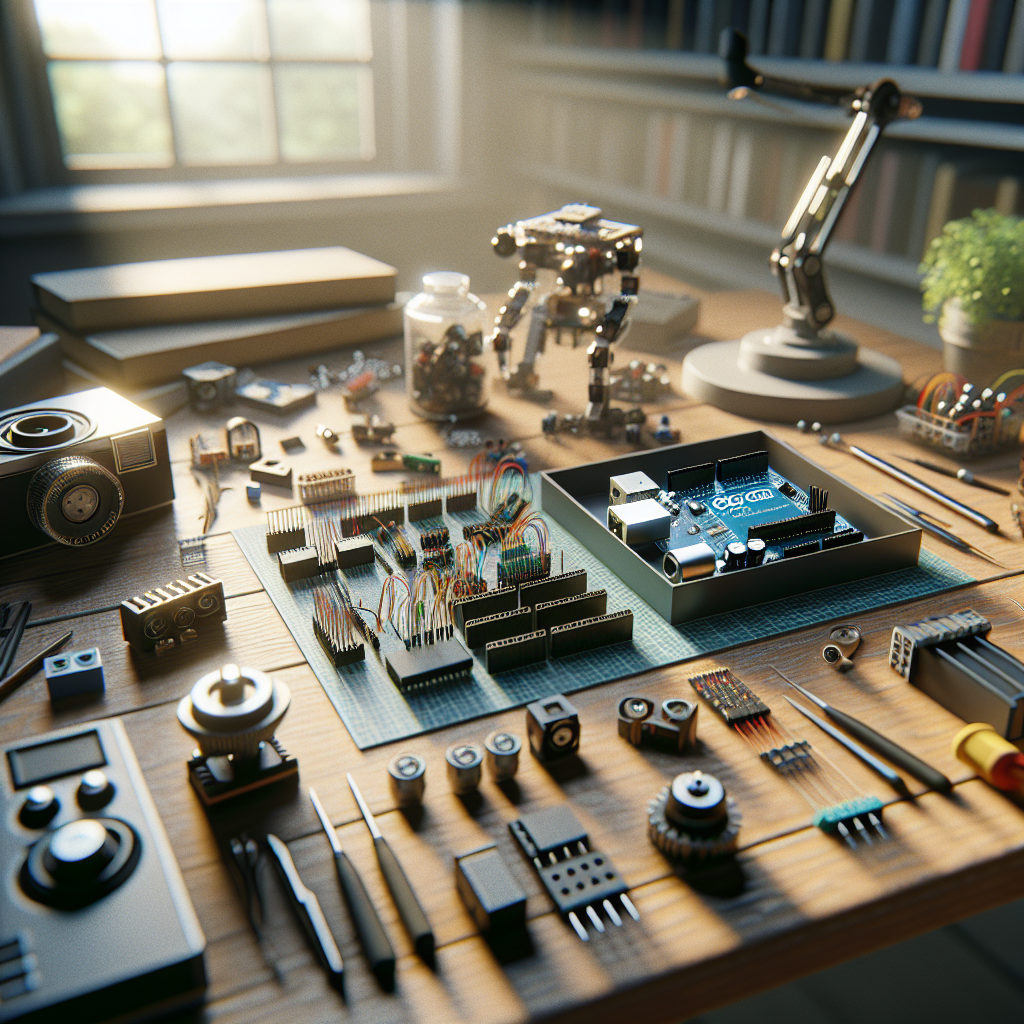
You don’t need an engineering degree to learn robotics—thousands of hobbyists, career changers, and curious adults have taught themselves with a $30 Arduino kit and a good roadmap. Robotics for beginners is more accessible than ever: the intersection of electronics, programming, and mechanical design can be entered from any direction. Whether you come from software, maker projects, or pure curiosity, a structured robotics learning path gets you from zero to building real robots. This guide gives you a structured robotics learning path with specific resources, tools, projects, and milestones at each stage. Whether you’re getting started with robotics from zero or you’re a software developer wanting to build physical robots, you’ll see exactly how to learn robotics step by step. Start with the big picture: read our guide to how robots work, then use this roadmap to go from “blink an LED” to a robot that navigates and senses. For definitions of terms you’ll meet along the way, bookmark our robot glossary.
Stage 1 — Foundations (Month 1–2)
Understand How Robots Work
Before you buy parts, get the concepts. Learn robotics from scratch by understanding sense–think–act: robots sense the world (sensors), process information (code and sometimes AI), and act (motors, actuators). Our how robots work article covers this; so do our guides to robot sensors and robot motors and actuators. You don’t need deep theory yet—just enough to know why you’re blinking an LED (output) and reading a sensor (input). What should I learn first for robotics—programming or electronics? Many people start with a bit of both: basic programming (Python or Arduino C++) and simple circuits on a breadboard. How do I start learning robotics with no experience? Begin with one of the free “intro to electronics” or “intro to Arduino” series, then get a physical kit so you can touch the parts and see the results of your code.
Learn Basic Electronics
Voltage, current, resistance, and Ohm’s law are enough to start. Practice with LEDs, resistors, and a breadboard. Free resources: SparkFun tutorials, Adafruit, and Khan Academy for math and electricity basics. Do I need to know math for robotics? Basic algebra is sufficient at first; linear algebra and calculus matter more for advanced topics like kinematics and control. Robotics for beginners adults and beginner robotics guide material often starts here—electronics fundamentals plus hands-on practice.
Start Programming
What programming language should I learn for robotics? Python is the most recommended for beginners: easy syntax, huge libraries (including for robotics and AI), and it’s what many courses and ROS use. Alternatively, start with Arduino C++ (simplified C++) if you want to go straight to microcontrollers. Free options: Codecademy, freeCodeCamp, and the official Arduino tutorials. Can software developers learn robotics? Absolutely—your software skills are a huge advantage; the gap is hardware integration and real-time systems, which you pick up by doing.
Get Your First Kit
An Arduino Starter Kit ($30–$60) is the standard “Hello, World” of robotics. Blink an LED, read a sensor (e.g. temperature or light), and control a motor. What is the best first robot project for a complete beginner? Literally: blink an LED, then make a motor spin on command. From there, a simple wheeled robot or a kit like the Elegoo Smart Robot Car is the next step. Robotics tutorial for beginners and where to start with robotics both point to this: one board, one breadboard, one motor, and code. Complete robotics learning roadmap from zero starts here—don’t skip the basics; they make Stage 2 and beyond much easier.
Stage 1 Milestone
You’re ready for Stage 2 when you can: blink an LED, read a sensor value (and print it or use it in code), and make a motor spin on command. That’s the robotics learning path foundation. If you can do those three things, you’ve got the core loop of robotics—sense, compute, act—under your belt.
Stage 2 — First Robot (Month 2–4)
Build a Simple Mobile Robot
An Elegoo Smart Robot Car Kit or equivalent ($50–$80) gets you a wheeled robot you assemble, wire, and program. You’ll add obstacle avoidance using an ultrasonic sensor and, with many kits, line following with IR sensors. What is the best first robot kit? An Arduino-based car kit like the Elegoo Smart Robot Car V4: comprehensive, well-documented, and it teaches wiring, sensors, and basic control. Kits in the $50–$80 range typically include the board, motors, chassis, ultrasonic and IR sensors, and instructions for obstacle avoidance and line following. How do I start learning robotics with no experience? Stage 1 gives you the basics; Stage 2 is where you build something that moves and reacts.
Add Sensors and Control with Code
Ultrasonic for distance, IR for line following, bump switches for collision—you’ll see how sensors feed into your code. Write your own obstacle-avoidance logic and experiment with simple PID-style control for line following. That’s closed-loop control in practice. Understanding how sensors and motors work together is covered in our robot sensors and robot motors guides. What tools and equipment do I need to start building robots? For Stage 2, a robot car kit plus a multimeter and basic hand tools are enough; our tools table below gives stage-by-stage costs.
Essential Tools
Breadboard, jumper wires, multimeter, and (optional for this stage) a soldering iron. Budget roughly $50–$150 for tools on top of your first kit. A multimeter is essential for debugging circuits; a soldering iron becomes important when you move to custom boards or connectors. If kit instructions mention PWM, encoders, or closed-loop control, look them up in our robot glossary.
Stage 2 Milestone
A robot that drives, avoids obstacles, and follows a line—all controlled by code you wrote. How long does it take to learn robotics basics? With consistent practice, many people hit this milestone in 2–4 months.
Stage 3 — Intermediate Skills (Month 4–8)
Level Up Hardware
Add a Raspberry Pi (Linux single-board computer) for more compute: camera-based vision, networking, and heavier software stacks. What’s the difference between Arduino and Raspberry Pi? Arduino: microcontroller, great for real-time hardware control, simpler. Raspberry Pi: full Linux computer, great for vision and AI, more powerful but more complex. Many intermediate robots use both: Pi for high-level logic and vision, Arduino (or similar) for low-level motor and sensor control.
Computer Vision Basics
OpenCV with Python: face detection, object tracking, color detection. Give your robot “eyes.” This is where robotics for beginners starts to touch the same tools the pros use. Free tutorials and courses are widely available; OpenCV’s own docs and PyImageSearch are solid next steps.
Introduction to ROS 2
Install ROS 2, run the tutorials, and understand topics, services, and nodes. Simulate in Gazebo so you can test without hardware. Our robot programming guide explains paradigms and where ROS fits. Articulated Robotics on YouTube offers clear ROS 2 tutorials. How to learn ROS Robot Operating System from scratch? Start with the official ROS 2 docs and a “hello world” node, then move to navigation or manipulation tutorials.
Mechanical Design
Basic CAD (TinkerCAD → Fusion 360) and 3D printing let you design robot chassis and mounts. Understanding mechanical constraints—weight, balance, cable routing—matters as soon as you move beyond kit builds. What math and physics concepts do you need for robotics? At this stage, basic geometry and a rough sense of center of mass and torque help; deeper kinematics and dynamics come in Stage 4 or with formal courses.
Stage 3 Milestone
A Raspberry Pi–powered robot with a camera that can navigate a room and identify objects. You’re now in intermediate territory on the robotics learning path.
Stage 4 — Advanced (Month 8–12+)
Machine Learning for Robotics
Reinforcement learning basics, sim-to-real transfer, training in Gazebo or Isaac Sim. Our guide to AI in robotics covers how ML is used in perception and control. Robotics learning path for software developers often accelerates here—you already know Python and maybe ML; the new piece is the physical robot and simulation.
Advanced ROS 2 and Specialization
Nav2 for autonomous navigation, MoveIt for arm manipulation, multi-robot systems. Then specialize: drone/aerial, manipulator arms, mobile robots, humanoids, or soft robotics. Robotics career path and how to become a robotics engineer often go through ROS and at least one specialization. Choose based on interest and job market: mobile and manipulation are in high demand; drones and humanoids are growing. Self-taught vs formal education for robotics: both work—formal gives depth and credentials; self-taught plus portfolio gives proof of skill. Many successful roboticists combine both.
Career Pathways
Robotics engineer, controls engineer, computer vision engineer, mechatronics—formal education helps for some roles, but a strong portfolio of projects is often just as valued. Do I need a degree to learn robotics? No. Many professional roboticists are self-taught; a degree helps for certain employers or research, but building and shipping projects matters. Is robotics a good career? Yes—the industry is growing; IFR reports millions of industrial robots worldwide, and salaries for robotics engineers in the US often range in the $95K–$130K median band. Robotics career path options include joining a robotics company, a research lab, or an automation-focused role in manufacturing or logistics; your Stage 3–4 projects become your portfolio.
Stage 4 Milestone
A custom-designed robot running ROS 2 with autonomous navigation—portfolio-ready. How long does it take to learn robotics? Basics in 2–4 months; intermediate confidence in 6–12 months; mastery is ongoing. How to go from Arduino beginner to building an autonomous robot? This roadmap is the path: Stage 1–2 get you to a working reactive robot; Stage 3 adds perception and ROS; Stage 4 adds planning, ML, and polish. Many people take 12–18 months of part-time effort to hit the Stage 4 milestone.
Best Resources for Learning Robotics
Online Courses
edX Robotics Courses (Penn), edX MITx, and MIT OpenCourseWare Introduction to Robotics are top-tier. Udemy has practical, project-based courses. Many are free to audit; certificates or credentials cost extra. Best free online courses for learning robotics include MIT OCW and the free tiers of Coursera/edX. What are the best online courses for learning robotics? For theory and structure, Penn’s Coursera specialization and MIT OCW are hard to beat; for hands-on, pair them with Arduino and ROS tutorials and a physical kit.
YouTube Channels
DroneBot Workshop (Arduino and hardware), Paul McWhorter (structured Arduino lessons), Articulated Robotics (ROS 2), James Bruton (advanced builds). Can I learn robotics online for free? Yes—Arduino tutorials, ROS docs, SparkFun/Adafruit, and YouTube can take you through Stage 2 and well into Stage 3. Robotics tutorial for beginners playlists on these channels are a perfect complement to this roadmap; watch a few, then build.
Books and Communities
Books: “Introduction to Autonomous Mobile Robots” (Siegwart), “Robotics, Vision and Control” (Corke), “Programming Robots with ROS” (Quigley). Communities: Reddit r/robotics, ROS Discourse, Hackster.io, local maker spaces, FIRST Robotics for mentoring. Robotics for beginners and getting started with robotics both benefit from a community—ask questions, share projects, get feedback. Best books for learning robotics theory and practice for beginners include the ones above; add “Make: Electronics” if you want more circuit depth before jumping to robot-specific texts.
Tools and Equipment Budget
| Stage | Essential tools | Approx. cost | Where to buy |
|---|---|---|---|
| 1 – Foundations | Arduino kit, breadboard, jumper wires, USB cable | $30–$80 | Arduino store, Amazon, Adafruit, SparkFun |
| 2 – First robot | Robot car kit, multimeter, basic hand tools | $80–$150 | Elegoo, Amazon, SparkFun |
| 3 – Intermediate | Raspberry Pi, camera, 3D printer (optional), soldering iron | $150–$400+ | Raspberry Pi Foundation, Adafruit, local electronics |
| 4 – Advanced | Depends on specialization (sensors, arms, drones, etc.) | $500–$2K+ | Vendor-specific, used market |
FAQ
Do I need a degree to learn robotics?
No. Many professional roboticists are self-taught. A degree helps for some career paths and research, but a strong portfolio of projects is often more valued by employers. Learn robotics by doing; supplement with courses and books as needed. Robotics for beginners adults and career changers often follow this path: build projects, document them, then apply to roles that value hands-on experience.
Should I learn Python or C++ first?
Python for most beginners—easier syntax, vast libraries, great for prototyping and ROS. Switch to C++ when you need real-time performance or are deep in embedded systems. What programming language should I learn for robotics? Start with Python; add Arduino C++ when you pick up a microcontroller.
What is the best first robot kit?
Arduino-based car kit: Elegoo Smart Robot Car Kit V4 ($50–$80). Comprehensive, well-documented, teaches wiring, sensors, and control. What is the best first robot project for a complete beginner? After blink and motor spin, this kit is the standard next step.
How long does it take to learn robotics?
Basics in 2–4 months with consistent practice; intermediate confidence in 6–12 months; mastery is ongoing—robotics is a deep field. How long does it take to learn robotics basics? You can have a robot avoiding obstacles and following lines in a few months.
Do I need to be good at math?
Basic algebra is sufficient to start. Linear algebra and calculus become important for advanced topics (kinematics, control theory, optimization). Don’t let math block you—you can learn it as you need it.
Can software developers learn robotics?
Absolutely. Software skills are a huge advantage. The gap is hardware integration, real-time systems, and physical intuition—all of which come with practice. Robotics learning path for software developers often moves fast through Stage 1–2 and then focuses on ROS and ML.
What’s the difference between Arduino and Raspberry Pi?
Arduino: microcontroller, real-time hardware control, simpler, lower power. Raspberry Pi: full Linux computer, vision/AI, more powerful, more complex. Many projects use both.
Is robotics a good career?
Yes. The industry is growing; IFR projects millions of industrial robots globally. Roles include robotics engineer, controls engineer, computer vision engineer, mechatronics. Median salaries in the US often range $95K–$130K for robotics engineers. Demand is strong in manufacturing, logistics, healthcare, and tech; robotics career path options continue to expand as automation spreads.
Conclusion
Robotics is uniquely rewarding because you create things that move, sense, and act in the real world—there’s no feeling like watching code you wrote make a machine come alive. Everyone starts with a blinking LED; the path from there to autonomous robots is well-mapped. Beginner robotics guide and how to get into robotics both lead here: a clear sequence of stages, resources, and milestones. The best way to learn robotics is to follow the roadmap and build as you go.
Learn robotics from scratch by following this roadmap: Stage 1 foundations, Stage 2 first robot, Stage 3 intermediate (ROS, vision), Stage 4 advanced (ML, specialization, career). Start with the fundamentals in our how robots work guide, get your first kit (Arduino or a car kit), and bookmark the robot glossary for terms you’ll meet along the way. Before you dive in, make sure you understand the basics: our robot vs bot vs AI explainer clears up the terminology. Your robotics learning path starts with one kit and curiosity—the rest is practice, community, and iteration. We’ll keep this roadmap updated as new tools and courses appear. Good luck—and welcome to robotics. Your journey starts now.